Coming Back from the Tuichi
Seven days in the Bolivian jungle, and what happened ninety minutes after we pushed our homemade raft onto the river.
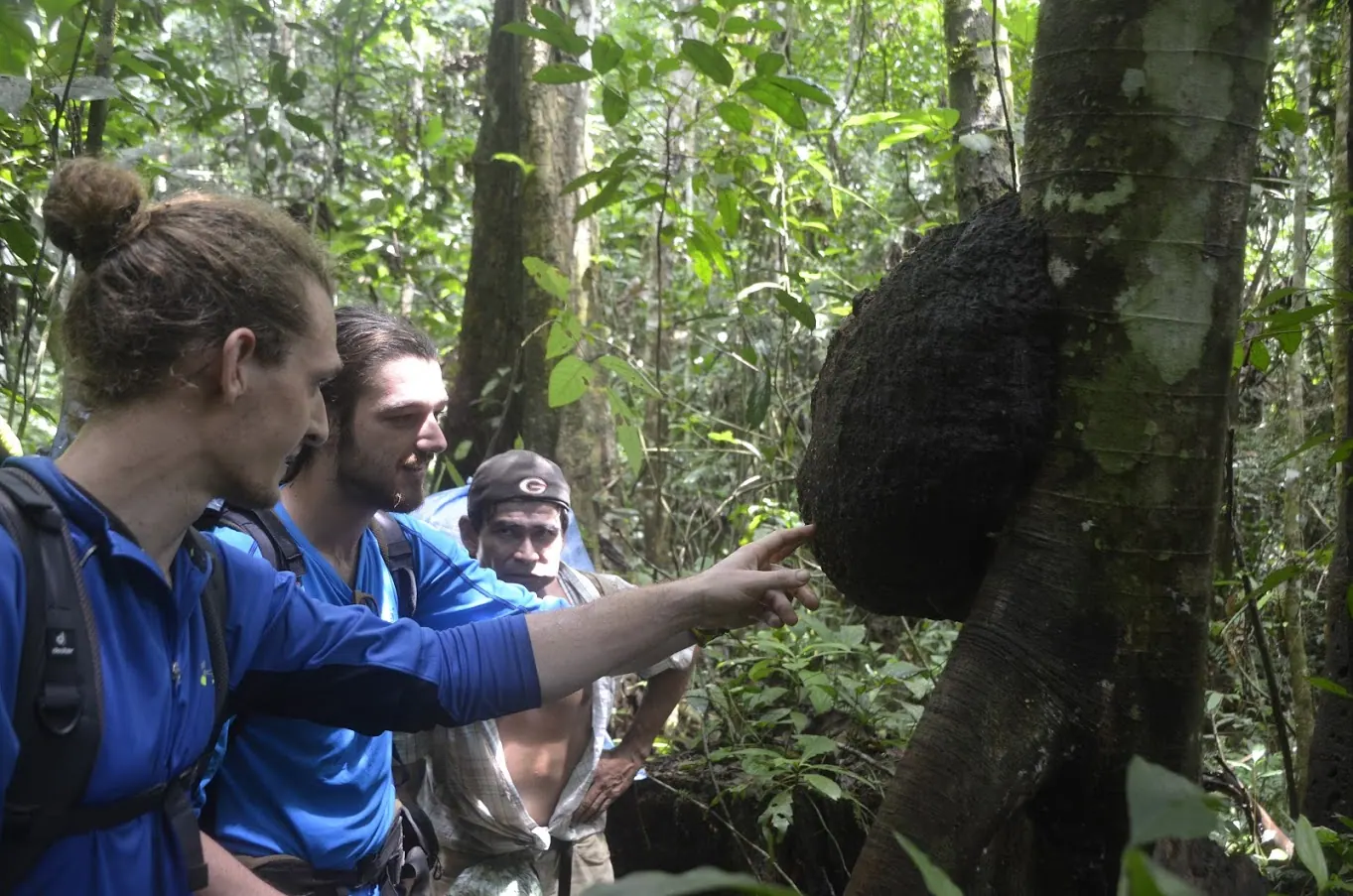
Rurrenabaque, Bolivia, April 2019.
Sunday. I get on a plane from La Paz to Rurrenabaque, a flight of less than an hour that feels like eternity, during which I regret the Subway I’d shoved down beforehand the entire way. Finally the plane levels out and thousands of kilometres of dense jungle open up in front of me. The nausea from the flight is replaced by excitement at a new adventure.
I step off the plane into a wave of tropical heat and into the unknown.
Right outside the plane I get into a tuk-tuk with a group of Brits, forget for a moment that I’m in South America and remember days travelling in the East. We get out of the tuk-tuk and everyone heads for the same agency, which I can see is appallingly touristy, so I drop the idea, move to the small door next to it and go into a family-run agency.
Inside I see the walls are plastered with recommendations in — Hebrew. Not the thing that most appeals to me at first, but it’s nice to feel at home for a moment before heading into the jungle.
I talk to Pepe, the agent, and he tells me something big is brewing. A seven-day trip with a Frenchman and an Australian. Five days in the jungle, building a raft, and then two more days floating down the Tuichi river. Like Yossi, he says excitedly. Like Yossi.
(For anyone who doesn’t know the name: Yossi Ghinsberg is an Israeli traveller who in 1981 got separated from his group on the Tuichi and survived three weeks alone in the jungle. In Israel it’s a story everyone grows up with. It later became the film Jungle.)
I leave the meeting encouraged but I’m in no rush to decide. I walk down Rurrenabaque’s main street with all the agencies, asking, checking, trying to understand what’s going on here.
One of the agents asks me: are you really up for full survival? Full survival is our daily life, I tell him, and he laughs and agrees with a smile.
After the long day I come back to my bed, do the sums and the comparisons, and reach the conclusion: seven days with the Australian and the Frenchman.
Monday. I go to book the trip, do the shopping and the last preparations. Tomorrow I’ll already be sleeping deep inside the jungle.
Day one of the trip. We set off — me, Jerry, Léo and José the guide.
A short day of a few kilometres. We get used to the weight, to the walking, to the fact that we’re going to spend the coming week in a way none of us has known until now: life in the jungle.
We reach a good patch beside the stream and set up our base camp.
We cook dinner, and afterwards, at José’s request, we all gather for a small spiritual ceremony in which we ask the help of Pachamama, mother nature, to help us get through the coming days successfully and safely — and each of us adds in his heart one more small thing he’d like to achieve this week.
How much we needed that ceremony, you’ll find out later on.
We watch the stars for a while and go to sleep in a mad amount of noise. In the jungle, life doesn’t stop at night either.
Morning of the second day. A refreshing wash in the river water and tea for breakfast, and we set off.
Today we go deeper into the jungle, learning about the plants and their properties, eating snacks from whatever we find along the way and drinking water from particular trees that José teaches us hold pure water inside them. It’s unbelievable how many treasures nature holds.
A challenging climb of several kilometres towards the end of the day makes things a bit hard for our Australian friend, who isn’t experienced at trekking, but with teamwork and a redistribution of the weight we get through it and reach the second day’s camp.
At the camp an interesting surprise is waiting for us: a tarantula. José immediately jumps on the find and sedates it with cigarette smoke, and we get photographed with the fearsome spider.
A good dinner with the addition of mushrooms we collected on the way, and off to sleep.
Third day in the jungle. Everything from before the jungle looks and feels very far away. We’re deep in the adventure and our survival senses are sharpening. We start a challenging walk along the stream: extraordinary butterflies, jaguar tracks, and green on every side.
Towards the afternoon we settle beside a stream and set up camp early. Today we start working for our food, and we go fishing. After hours of trying it comes: a manta ray.
Wait — a manta ray? Who eats that jellyfish with eyes? If you ask José: we do. He hurries to reassure us, cuts it up expertly, wraps it in a leaf he picks from one of the trees and cooks us a delicacy fit for a king. The jungle doesn’t stop surprising you, and José’s command of it makes you realise there are whole worlds of knowledge that you, as someone who grew up in the modern world, simply don’t know. Wow.
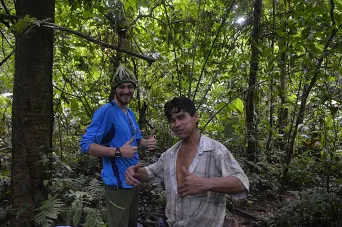
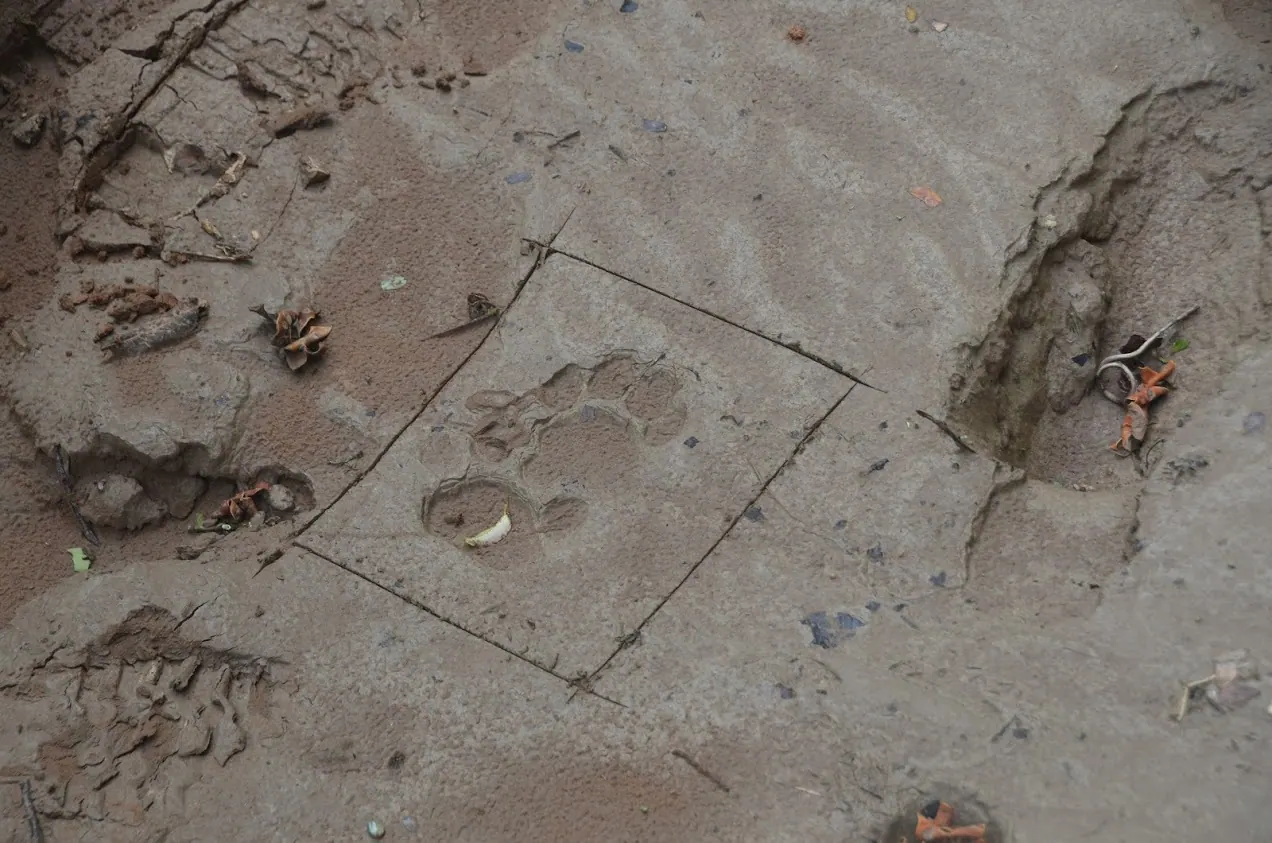
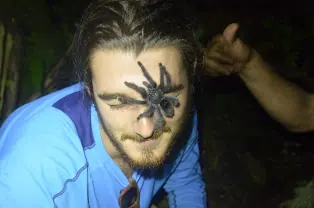
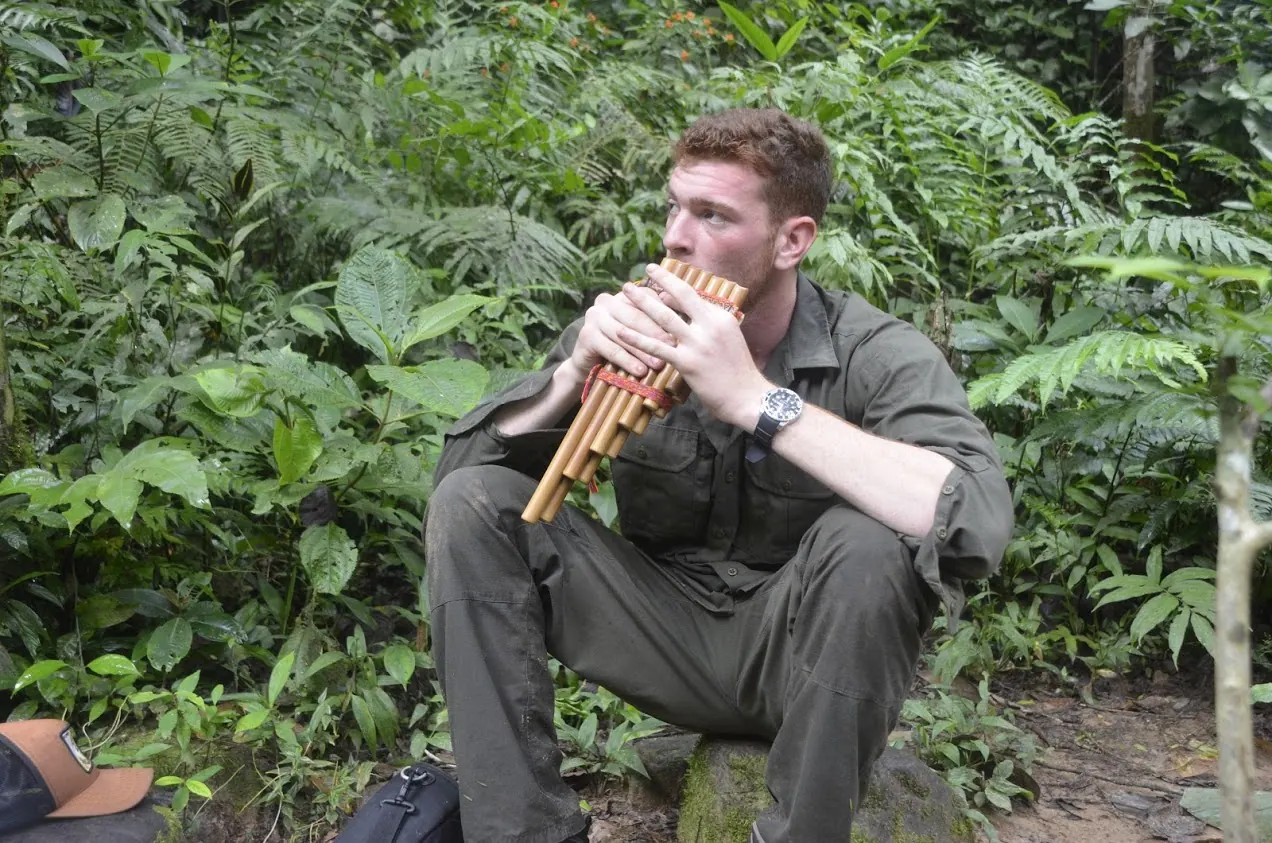
Moments in the jungle.
Fourth day. We wake up with seized-up legs but carry on with the journey.
Walking along the stream, which slowly gets wider, and every so often taking shortcuts through endless forest. How José manages to know where he is, God knows. In among the trees, monkeys and snakes appear to us. The Jungle Book, live.
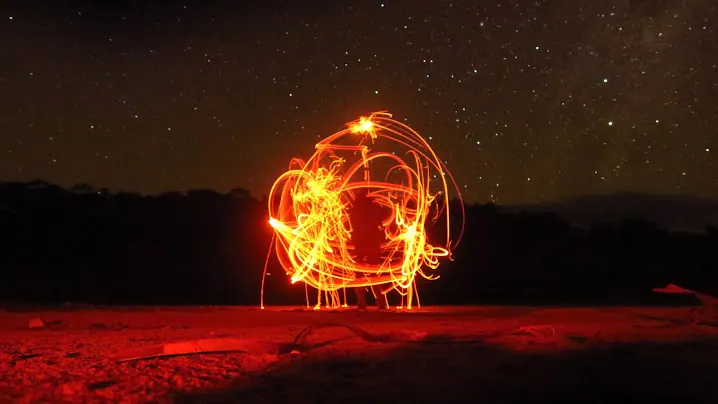
At night we set up camp on the bank of the wide river, enjoying the fact that tomorrow is the last day of walking, and go to sleep late — conversations into the night, night photography and a bit of fire.
Fifth day, the last day of walking. We gather our strength again. The jungle already feels like home; time does its work. A relatively short walk today, more time to stop and enjoy the way.
After a few hours, in enormous excitement, José announces: friends, look ahead. In another 500 metres we join the river. The legend, the myth, the Tuichi.
We lift our heads off our tired shoulders and see it in all its glory and force. Yossi’s film runs in front of our eyes and we realise we’ve done it. The walking is over.
On the last night, ahead of two relatively easy days physically, we head out to discover a different jungle: the jungle at night. Two hours of exemplary silence and maximum alertness with the camera give us extraordinary moments of nature, and a near-encounter with a jaguar which we hear running beside us but don’t manage to see for more than a second.
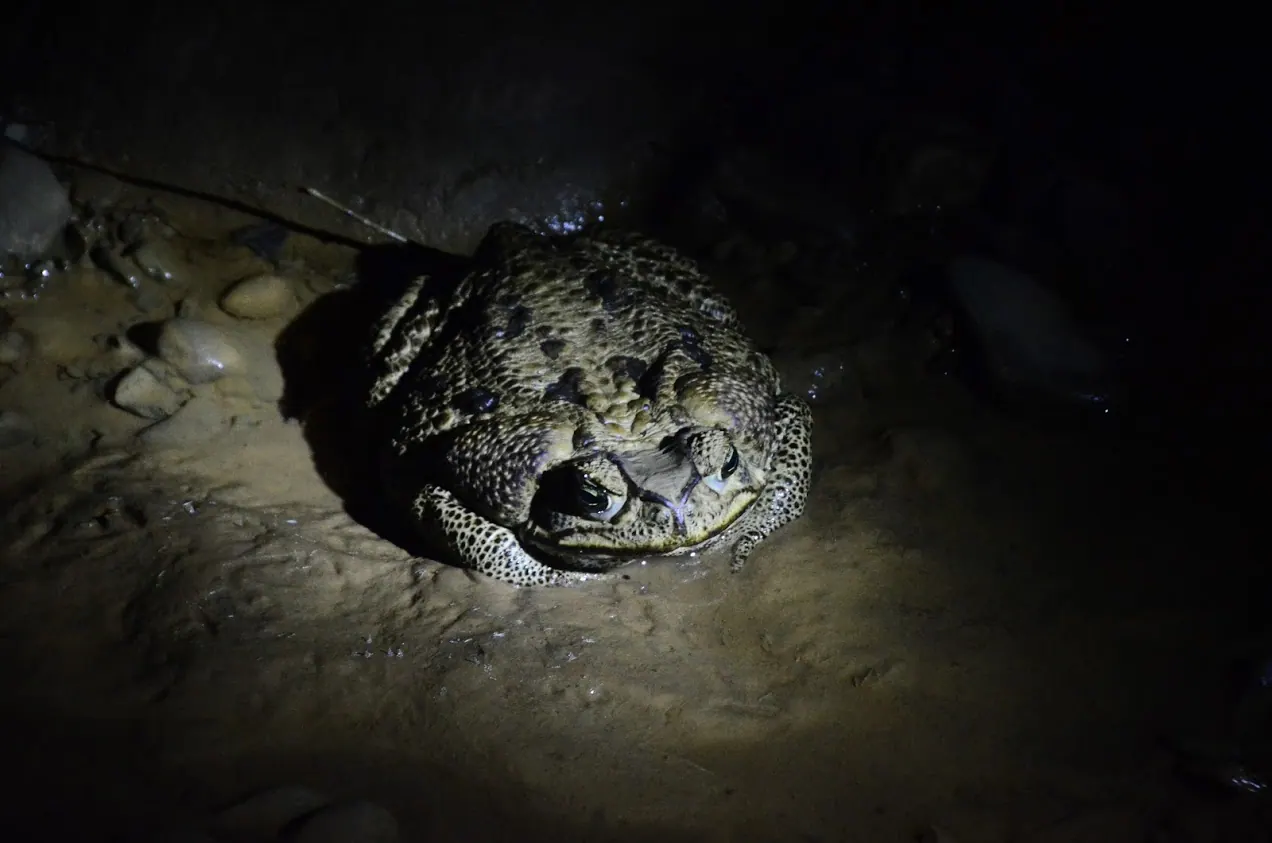
Night in the jungle.
Sixth day of the journey. We get up in the morning thinking the physical part is behind us, but José hurries to explain that before we board our “pleasure cruise” on the Tuichi there’s one last challenge ahead: building a raft from nothing but what nature provides.
Full of motivation we head out with José to look for balsa trees — light but strong, a perfect answer. After a short walk we reach an area with several large trees and start felling them with our machetes, which over the course of the days have already become part of the hand.
After bringing the trees down we thought the work was finished, but José, with a mischievous smile, cools our enthusiasm and starts showing us how to strip the bark off the trunk.
After three hours in which we brought down eight trees, two per person, we float them down the shallow river to the junction with the Tuichi, where we haul the logs up onto the last stretch of bank a few metres from the river. Meanwhile José has been running around the jungle bringing us rope he makes from a palm tree. Unbelievable that all of this exists in nature.
Then comes the fun stage. Under José’s instruction we learn to tie the knots in the right direction and assemble the raft properly. After an hour of building we’re ready — or at least José says we’re ready, because the Australian, the Frenchman and I look at each other and don’t really believe we’re getting onto the Tuichi on trees we cut only two hours ago. But nobody quite dares say anything and ruin the sense of adventure burning in all of us.
We load the gear and tie it down well, push the raft into the river, and the moment arrives.
Almost a week ago I got off the plane and Pepe from the agency told me I was going to be on the Tuichi on a raft like Yossi. And here I am. Exactly like Yossi.
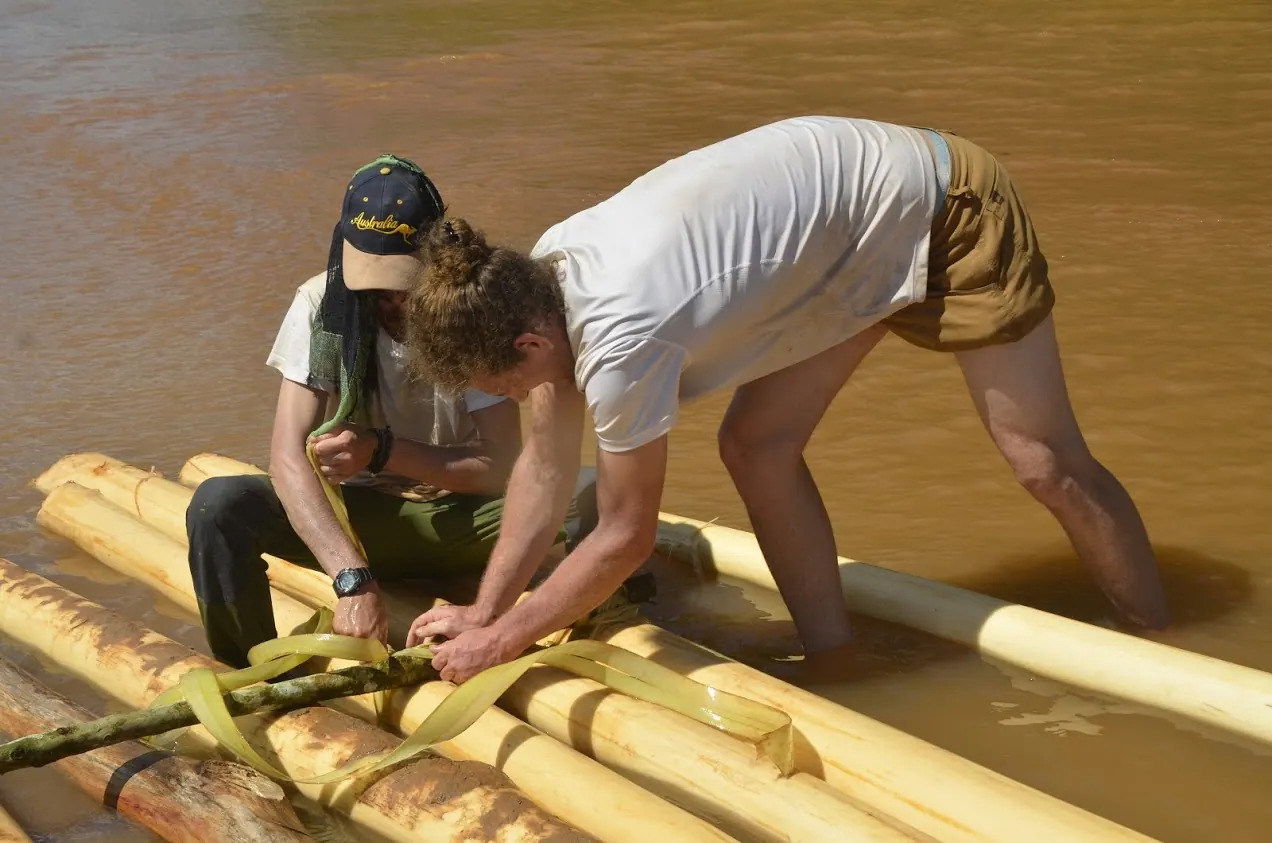
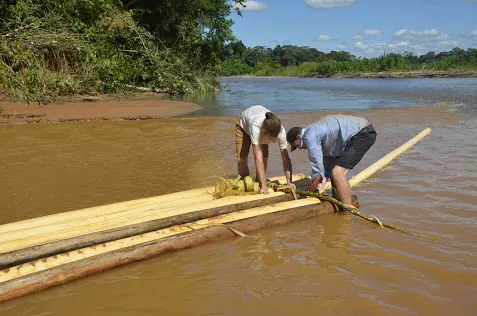
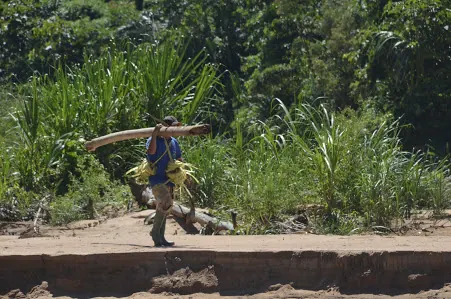
A raft straight from nature.
And so we float down the river, paddling in pairs and swapping every half hour, seeing the green jungle from the outside and enjoying the calm and the view. On the way we see a motorboat of tourists doing what’s known as the luxury jungle tour, and they look at us in shock, probably wondering to themselves whether three travellers have been kidnapped by a local.
An hour passes on the Tuichi like that. Strong currents now and then, but we feel comfortable and in control of the raft. Nothing prepares us for what’s coming.
An hour and a half into the raft trip, Jerry the Australian and I swap with Léo and José. The river looks normal, but after a few minutes I see there’s something strange ahead of us: a particularly strong current. We’re several days into the jungle by now and we’re not quick to get worked up over nothing, but as we get closer to the current I realise there might be something big here. I turn to tell José, who has already worked it out himself and is shouting at us with all his strength to paddle hard left and get away from the current. The tension rises and the four of us try with everything we have — but it’s already too late.
We’re swept into a strong current to the right where we no longer have any control of the raft. We’re in the hands of fate, and fate pulls us into a strong current to the left that leads to only one place: an enormous island of trees floating in the middle of the river. A great mass of timber getting closer every second at dizzying speed, and in those moments I don’t know what to expect. Will I be thrown onto the island and take the impact? Will we be thrown into the raging river and drown? A few seconds of uncertainty in which your life flashes in front of your eyes and you don’t know what’s about to happen to you.
And then it happened. We hit the floating mass of trees at speed.
Jerry, José and Léo, who were in the central part of the raft, wedge into the timber with the raft and manage to climb safely onto it.
I, with a little less luck, am at the rear of the raft which doesn’t wedge into the timber, and I’m thrown into the water. I grab the raft at the last moment and don’t understand the scale of the danger. I’m swallowing water and starting to drown, and if I let go with my shaking hand I go into the current under the island of trees, which I probably wouldn’t have come out of.
But I don’t grasp the situation and I shout to my friends: My water bag! Yes — I’m on the brink of death and I’m worried that my hydration bladder is about to fall into the river and disappear forever. My companions are rather clearer-headed and are screaming at me to give them a hand and get up onto the timber. I reach out and together they lift me up. That’s it, we’re all safe on the island of trees.
After a minute of recovering and understanding what has happened to us, like real survivors we’re already planning what to do next.
José, like a carefree jungle child, announces that we’re continuing the journey. I’m still in shock and don’t respond, but the Frenchman and the Australian, who can see how our raft is stuck in the current, shout at José and tell him the journey is over and we’ll be risking death if we carry on. José struggles to believe his legendary raft has failed the journey, but after some persuading he agrees, and we all understand: the journey is over.
We haul the soaked gear up off the raft and wonder to ourselves: what now? We’re on the edge of darkness, we have no food, all the gear is wet and we’re in the middle of the river with no way of reaching either bank.
After a few minutes of thinking, fate decided for us.
Remember the luxury jungle tour? Here it comes back, this time as the chief saviour. The tour’s motorboat had dropped off its tourists and was heading back towards Rurrenabaque.
The man in charge of the boat saw us on the island of trees and immediately came to our help.
And so, after six days in the jungle instead of seven, on a motorboat, Jerry, Léo, José and I make our way at sunset along the Tuichi river, grateful for the privilege of being alive and with new experiences for the pack.
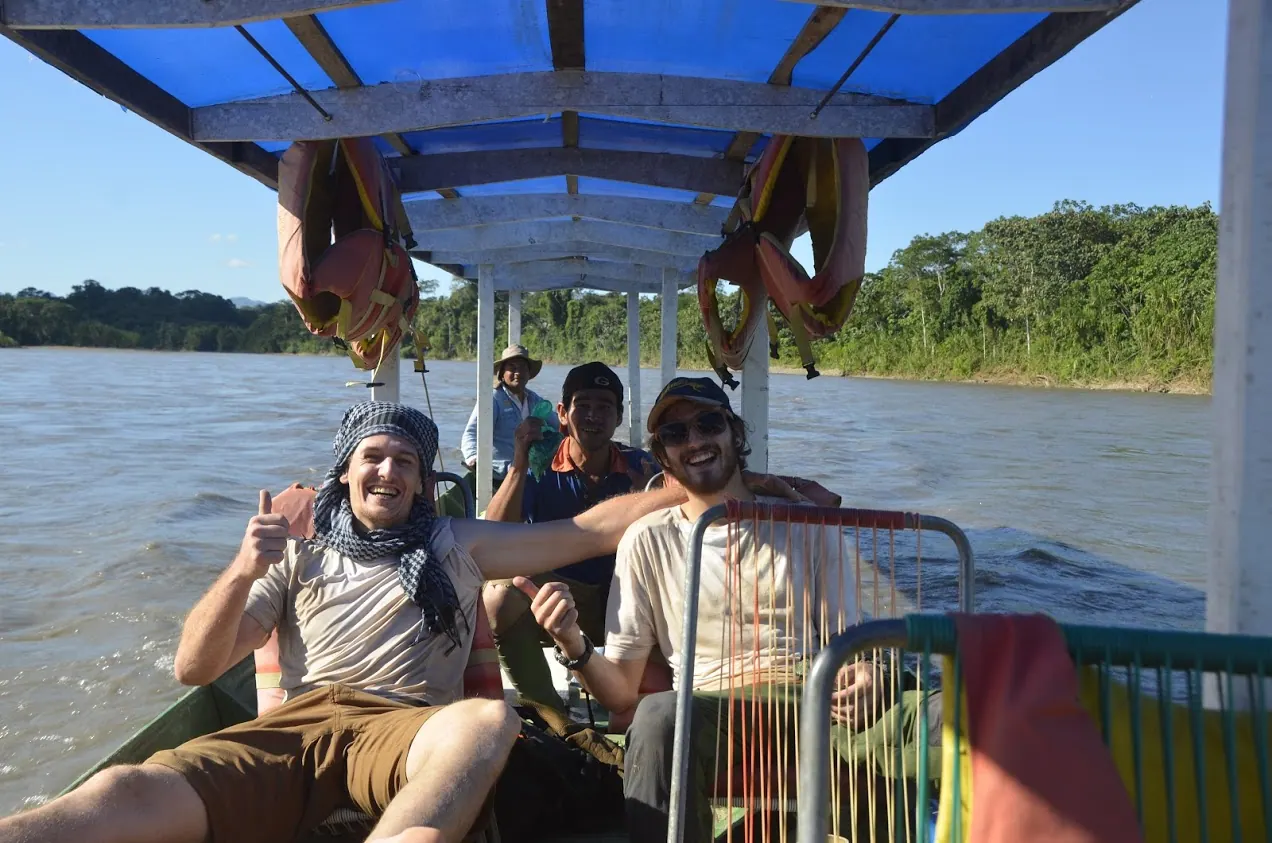
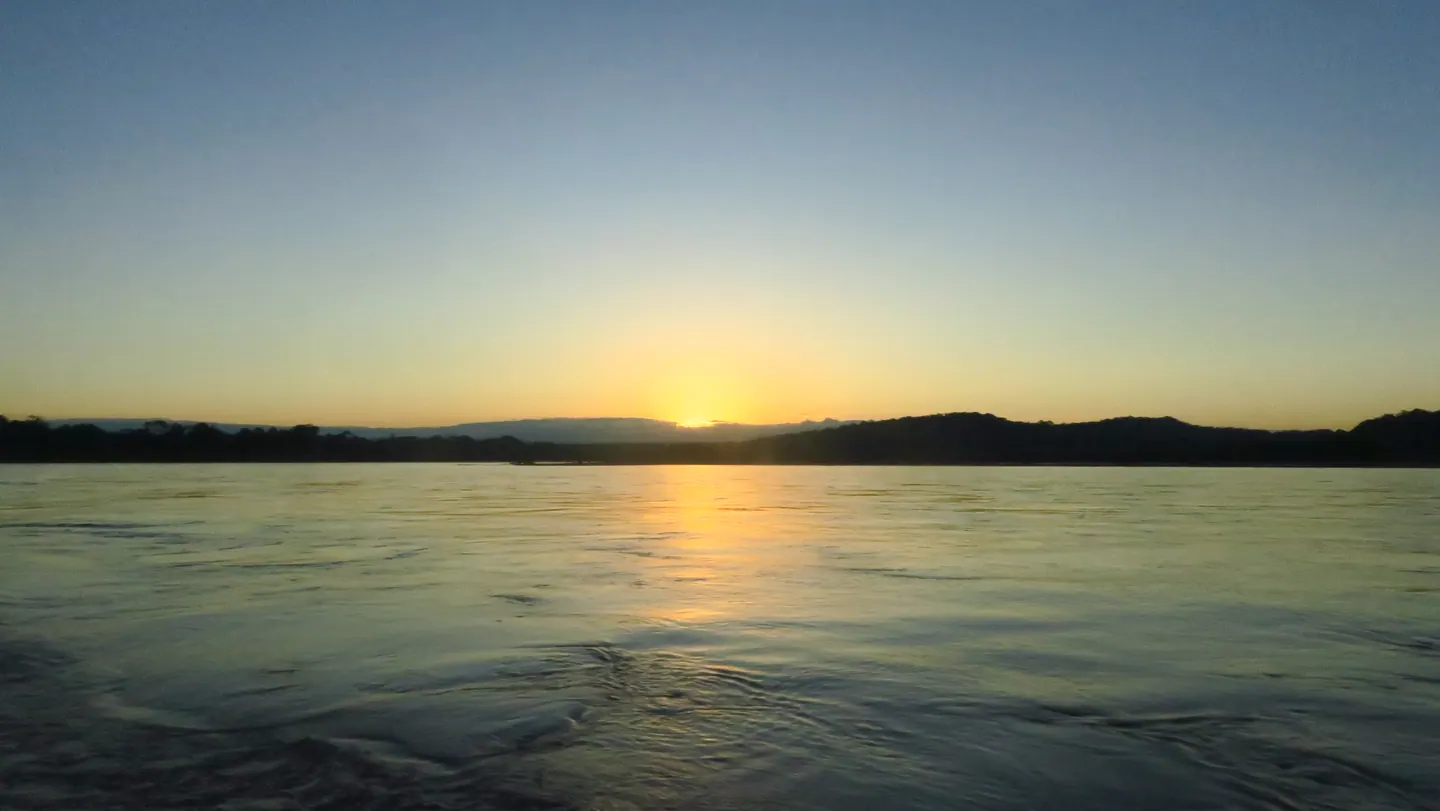
Heading back to Rurrenabaque at sunset.
So what do we take from this road story?
José the guide’s phone number: +59173097859
The jungle is an extraordinary place and a school for life. If you can, don’t go on the luxury tour — challenge yourself with semi-survival or full survival.
You need to know when to stop. And even if the guide is sure of himself and wants to save the situation, know how to stand your ground and tell him you want to stop here.