Salt, Water and a Lot of Oil — Uyuni by Self-Drive
Nine days crossing southern Bolivia in a hired jeep that wasn't built for it. Two punctures and a hole in the sump.
March 2019, Sucre, Bolivia
This road story is a little longer than usual, but I see in it the embodiment of travelling alone: between the highest moments and the lowest, between complete freedom and helplessness, and inside all of it moments of magic that can’t be put into words.
This story begins in Salta, northern Argentina. I’m waiting for a Bolivian visa when a German guy I’ve met tells me about his experiences on a three-day trip to the Salar in Bolivia. Beyond the famous salt flat, he talks about an entire desert with natural phenomena no less extraordinary than the Salar, and he stresses: I wish I could have been there alone, without a guide and a timetable, enjoying it my own way.
The German’s words made me think, and after a day with the idea buzzing in my head I decided to go to a local internet shop in Salta and look for information. Between TripAdvisor and a few anonymous blogs (almost like this one) I saw there isn’t much information on the subject online — but also that the idea is doable.
I put everything I’d gathered into a document and started looking for partners. The first, of course, was Raz, an adventurer like me who’d been with me in Salta and agreed to the idea.
Me, Raz and one mad idea. We cross the border into Bolivia and arrive in Uyuni.
In Uyuni we did a few more checks with the agencies, learned the ground, and at the same time got a positive signal from a friend of Raz’s — Shoham, who was willing to join us in a few days. The dream becomes reality.
We start work. According to our checks, all the preparations for a trip like this can only be done in Sucre, the capital, about six hours’ drive from Uyuni. Raz and I get on a night bus and arrive in Sucre.
Sucre, Bolivia’s pleasant capital. We reach a cool, hipster hostel — who has the energy right now for preparing a jeep trip in the desert? After a day of indulgence, Raz and I remember why we came here and start combing the city, beginning with the most important thing: the vehicle.
We got the names of five agencies. Two don’t exist, one has closed. We’re left with two. Welcome to Bolivia.
After enquiries and negotiation, because of the price difference we decided to go with Bolivia’s ordinary car hire company — which doesn’t really let you enter the salt flat or do as you like with the vehicle, but offers an attractive price — rather than the second hire company, which genuinely supports the Salar idea and promises you a vehicle specifically for the mission. Sound like a mistake to you? Wait and see.
So we have a vehicle. What’s missing? Just about everything.
We’re setting out on a journey through the desert, to places where we may not have water or food, and we have to equip ourselves accordingly.
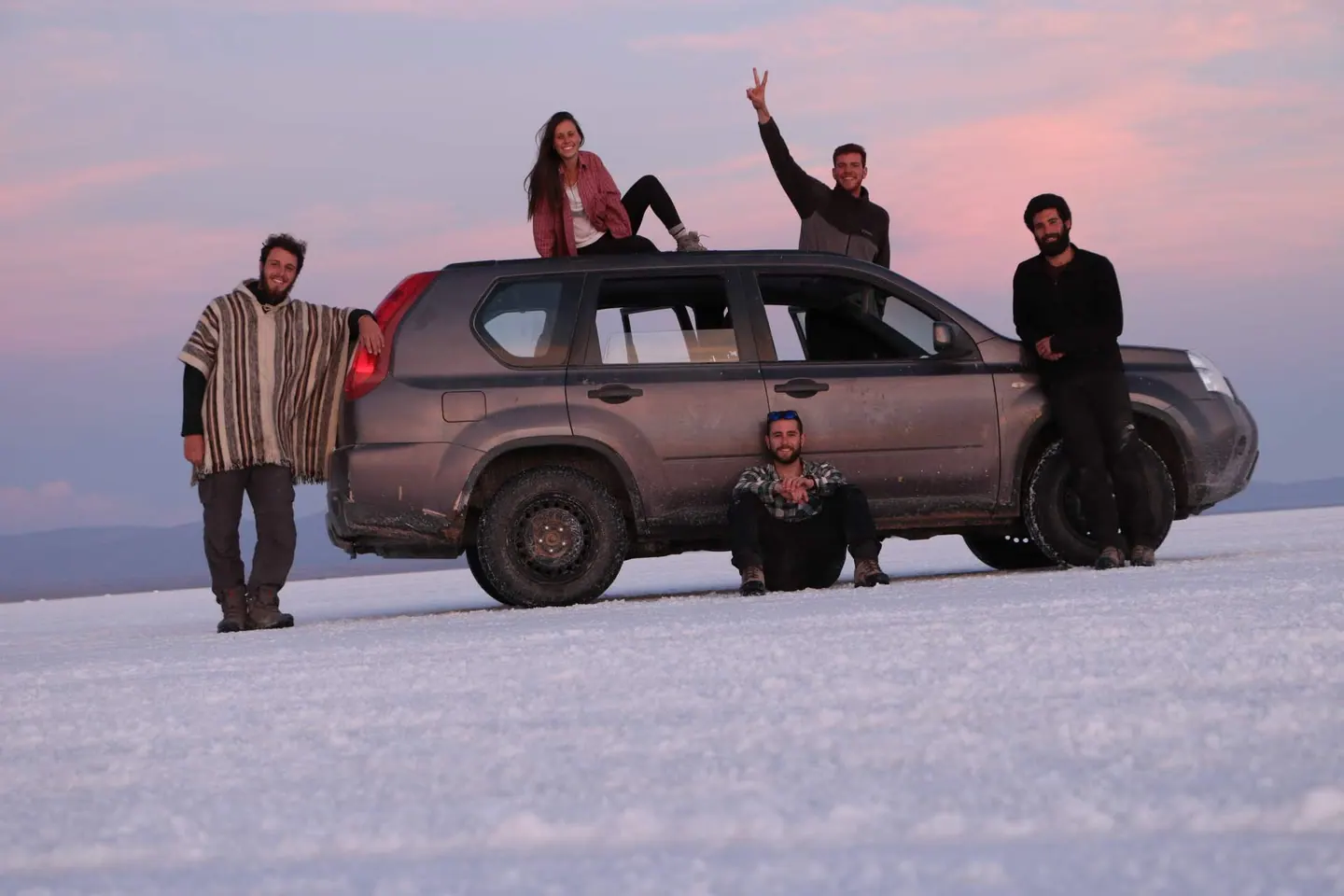
Shoham joins us for the shopping day and we head out with the hired jeep, a Nissan X-Trail.
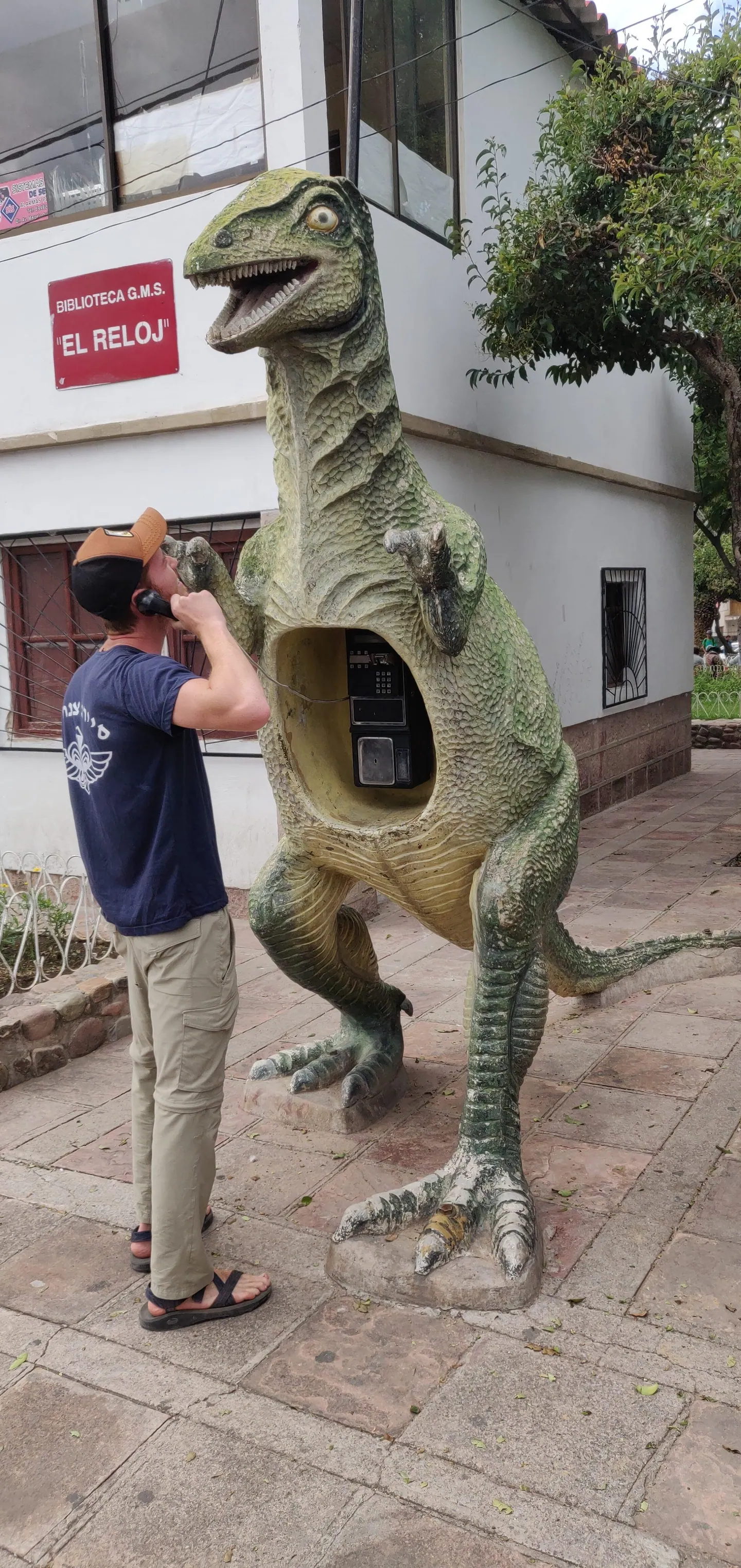
On this day we discover the wonders of Sucre’s local market, the Mercado Campesino: the place where there’s everything, whole streets making up a city where all of Bolivia’s commerce happens. And exactly like Bolivia, it’s all chaos, nothing is clear — but there’s something in the authenticity and mystery that makes this place magical and distinctive.
The local Bolivians can’t understand where these gringos have fallen on them from, the police are impressed by our height and get photographed with us, and so we spend a whole day between the various stalls and traders gathering gear for the road.
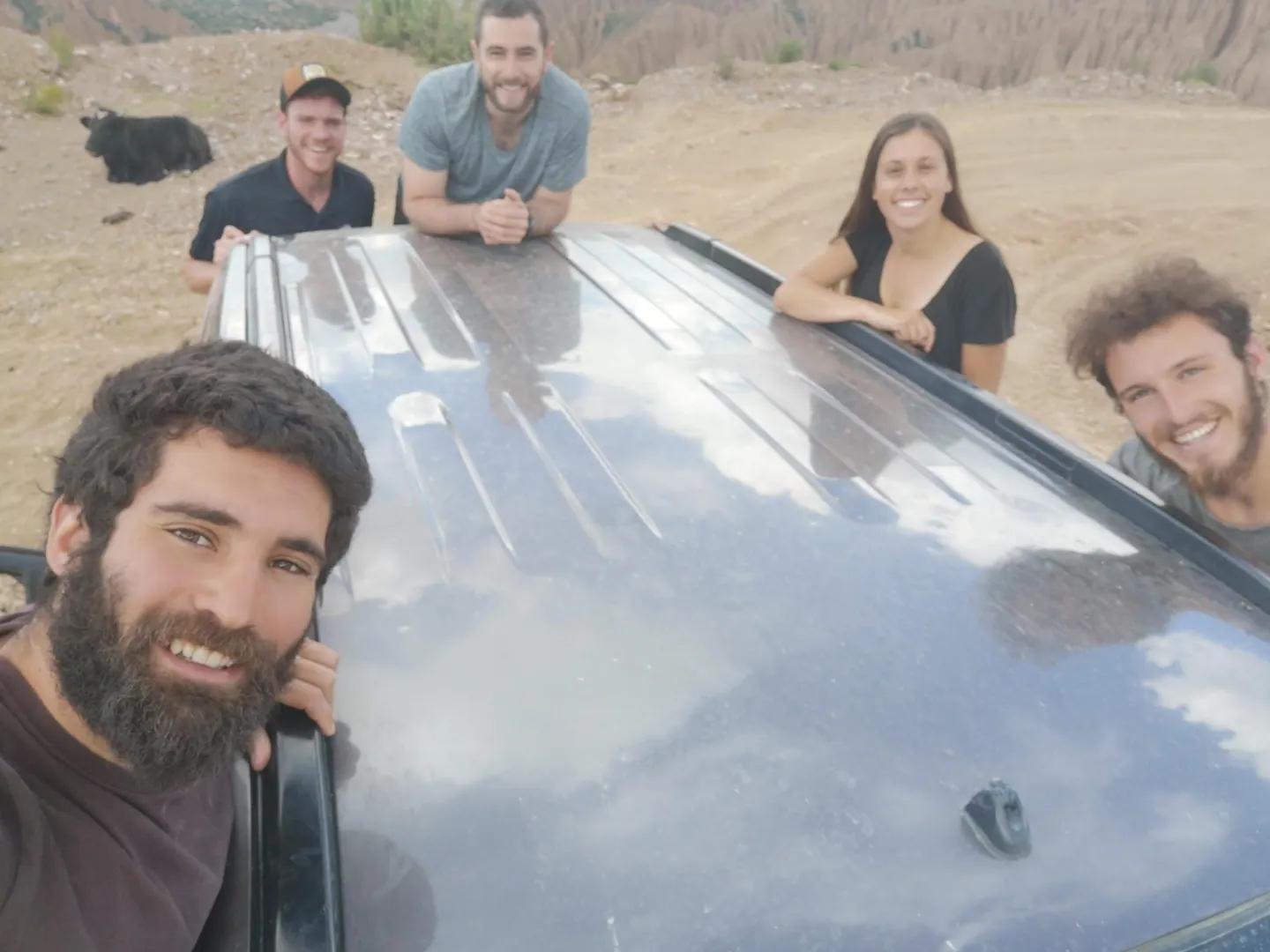
Towards evening, when we’re loaded up ready to leave the next day, we get another signal from an Israeli couple who want to join us: Neri and Einav. The vision becomes reality. A full car is going to conquer southern Bolivia alone.
Morning of the second day
We leave the unnecessary gear at the hostel and get in the car heading for Uyuni. A long day of driving passing through improvised roadblocks collecting surreal government taxes — they get the equivalent of a couple of shekels and they’re delighted, and we carry on our way. On the way to Uyuni we manage a short visit to Potosí, a lovely city where, exactly while we’re there, one of the schools is holding a colourful procession. (Sounds special, until you get to Cusco and see processions every day.)
At the end of the day we reach Uyuni and join up with Neri and Einav, our partners for the journey. Card games into the night and talk about what’s ahead of us. We go to sleep. Tomorrow we set off early.
Morning of the third day
We wake full of motivation. I go and ask the hostel manager a few questions and it turns out he’s the right person: he used to own a tour agency.
He recommends we don’t go straight into the desert but go via Tupiza, the last way out before entering the desert, where we can make all the final preparations.
On the hostel manager’s advice we set off at midday full of motivation.
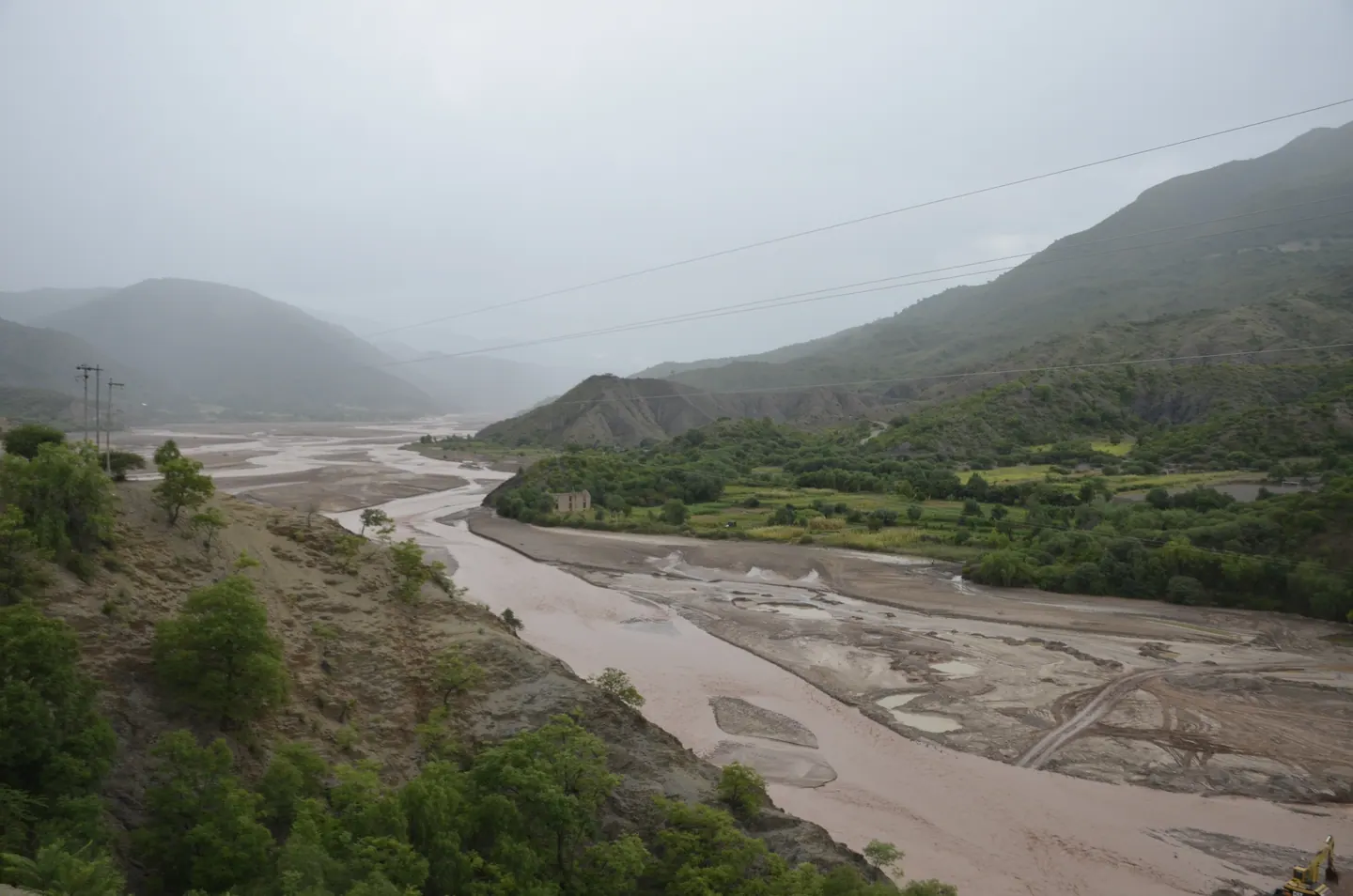
On the way to Tupiza we slowly move further from civilisation and pass through villages you can’t be sure still exist today. We leave the main road several times, but in the end those detours, adventurous as they were, turned out on this day to be a big waste of time. The last part of the drive to Tupiza is entirely off-road and we arrived there in the dark — and there the problem that would follow us for the whole trip revealed itself: our jeep struggles to carry the weight and gear of a full car. When we hired it there were only three of us planned, and although it’s spacious and large, it isn’t high enough.
Late at night we reach the town of Tupiza, where I see a form of transport I didn’t think I’d see again in my life: the Thai tuk-tuk. Beyond that the town itself is nice and small, an oasis.
We arrive at a hostel with a slightly drunk owner who opens the kitchen for us, and on our last night before we cut off entirely from the outside world we put away a bottle of spirits and, of course, don’t miss a clip by an Israeli comedian released that day, to lift the mood.
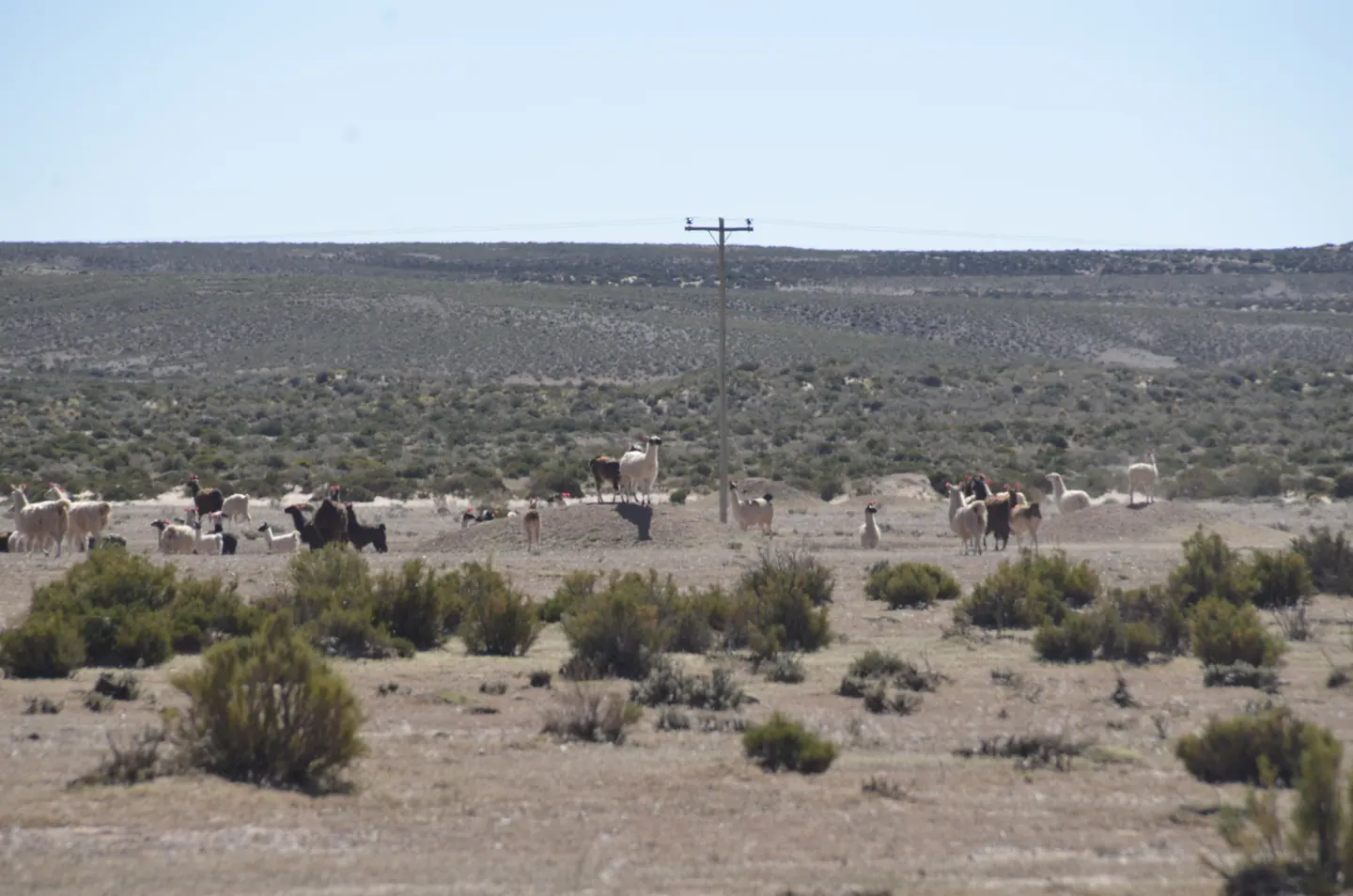
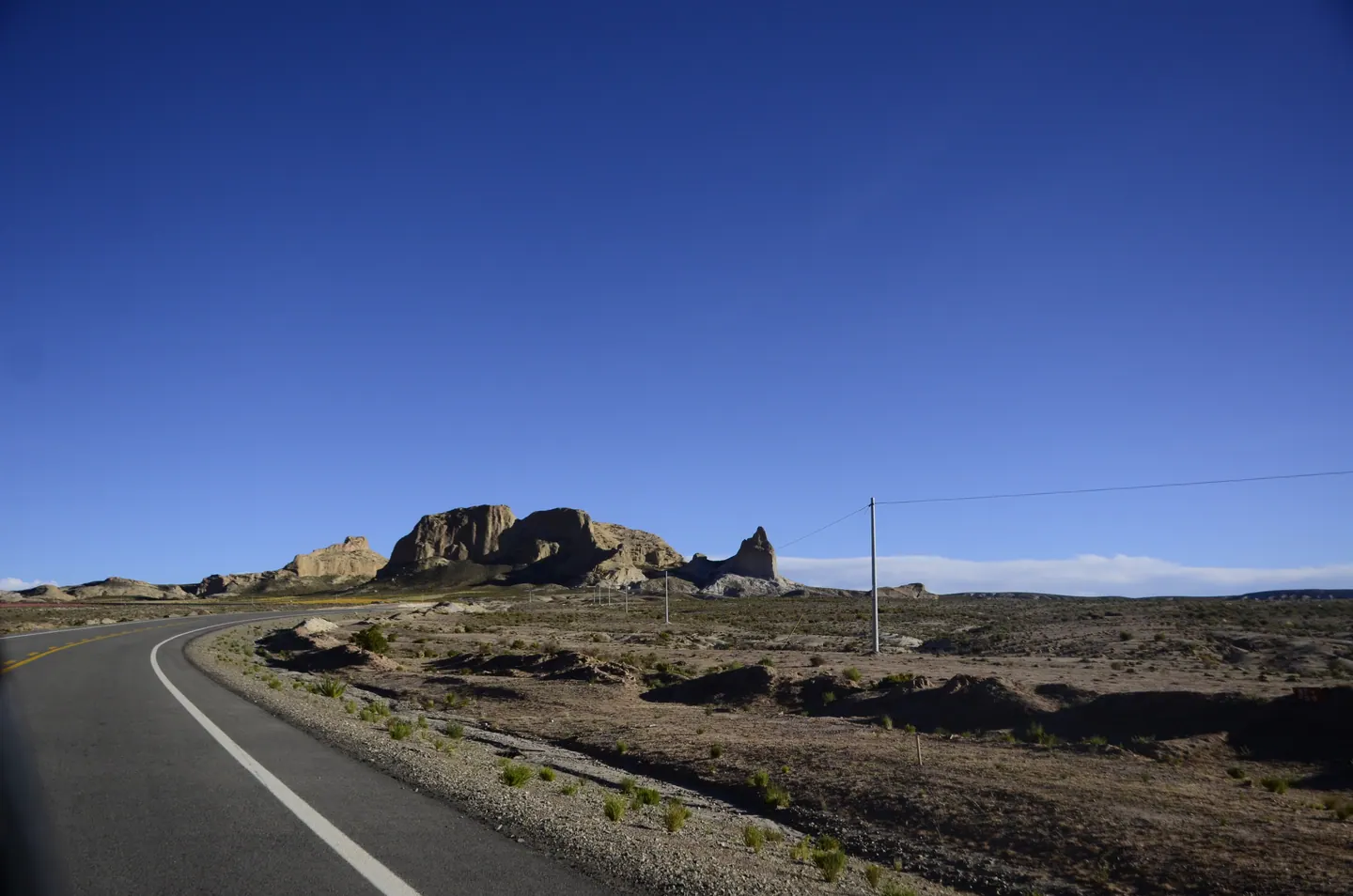
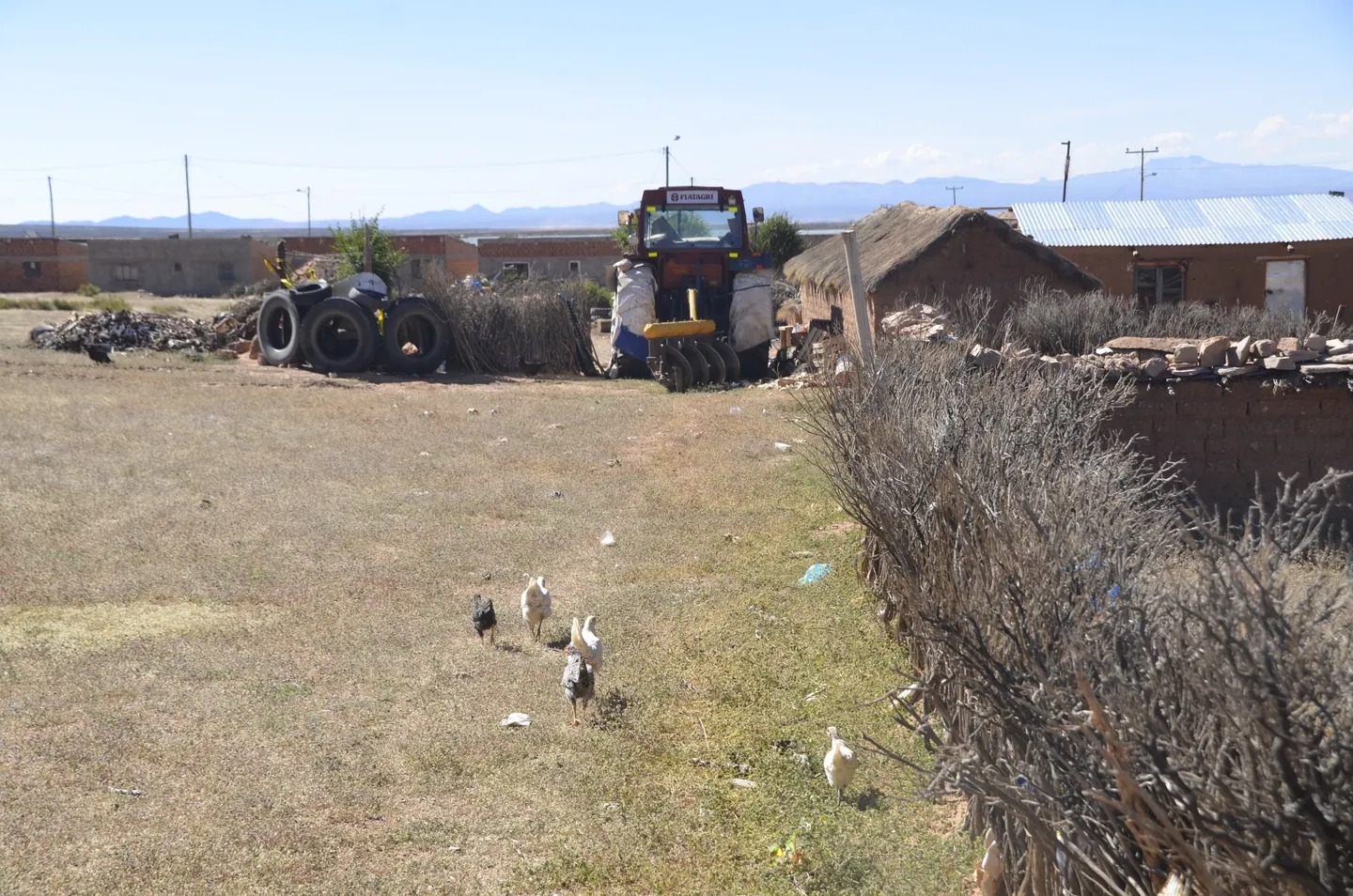
The fairly desolate road between Uyuni and Tupiza.
Morning of the fourth day
We get up early, enjoying a bit more civilisation and being able to actually find places on the map.
Before leaving Tupiza we look for an attraction outside town, and for that you need to get to the tourist information office, on the second floor of the town hall in a small room.
The clerk who opens the door for me can’t believe I’m genuinely a tourist and throws a hundred already-dusty brochures at me. An amusing situation, and I come out with the information I need. We’ll spend the morning outside Tupiza at a place called the Devil’s Gate — a fine rock formation and, practically speaking, a place for a morning brew and shakshuka.
On the way there we test our navigation skills and the jeep on somewhat serious terrain, and the truth is that we both fail fairly badly. We finally reach the spot, and as we get out of the car we realise we have a puncture.
Luckily we set out with two spare wheels, and we’re still outside the town.
We change the wheel, have a morning shakshuka, and go back to Tupiza to find a tyre shop.
Despite the delay we gained a moment of humanity. In moments like these you’re stuck in the middle of nowhere and the person helping you knows he’s the only one who can — but at this particular tyre shop we meet a lovely guy who just wants to help, and when he tells us the price we try not to laugh. We gave him a bit extra for the honesty and carried on our way.
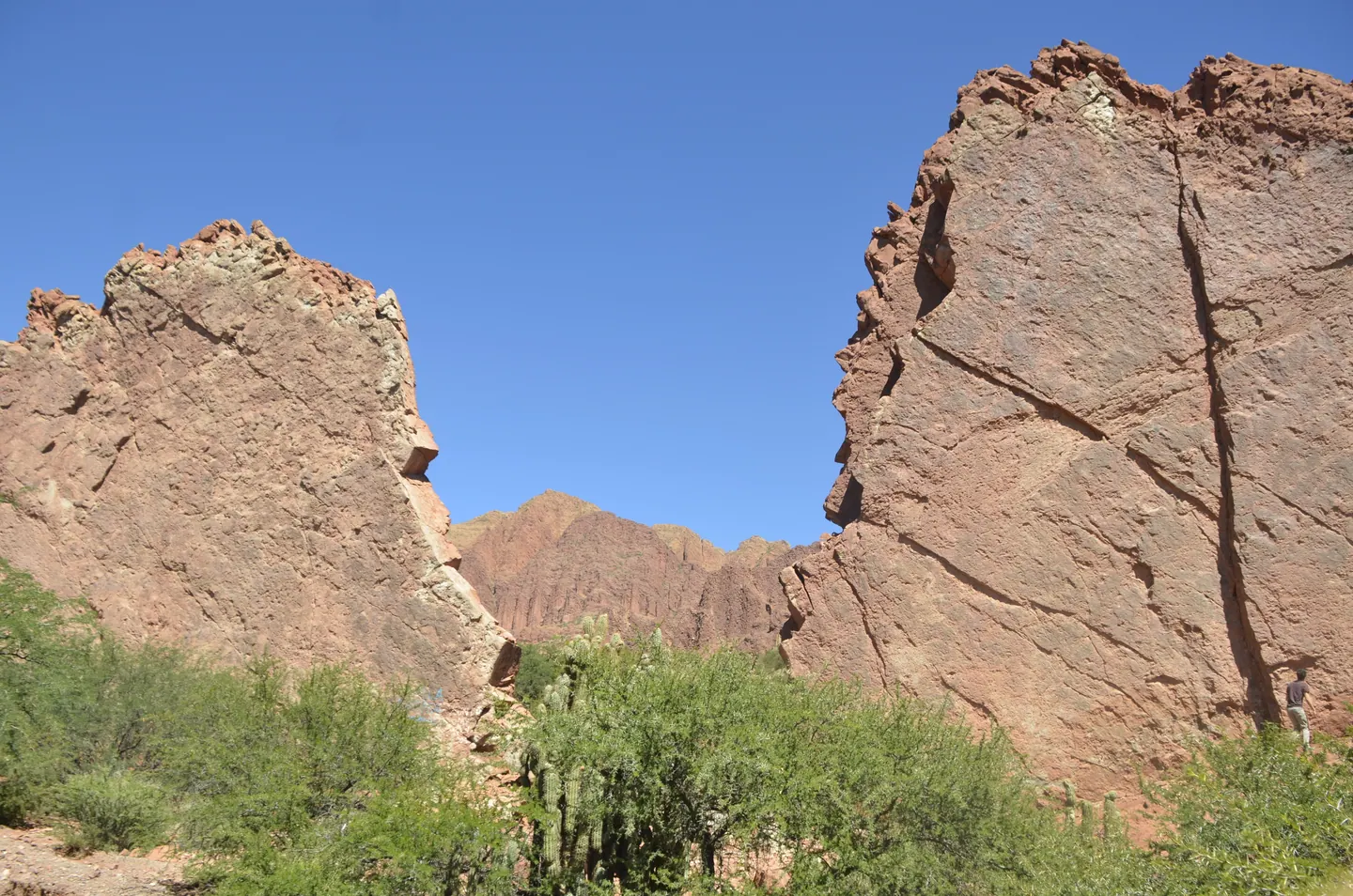
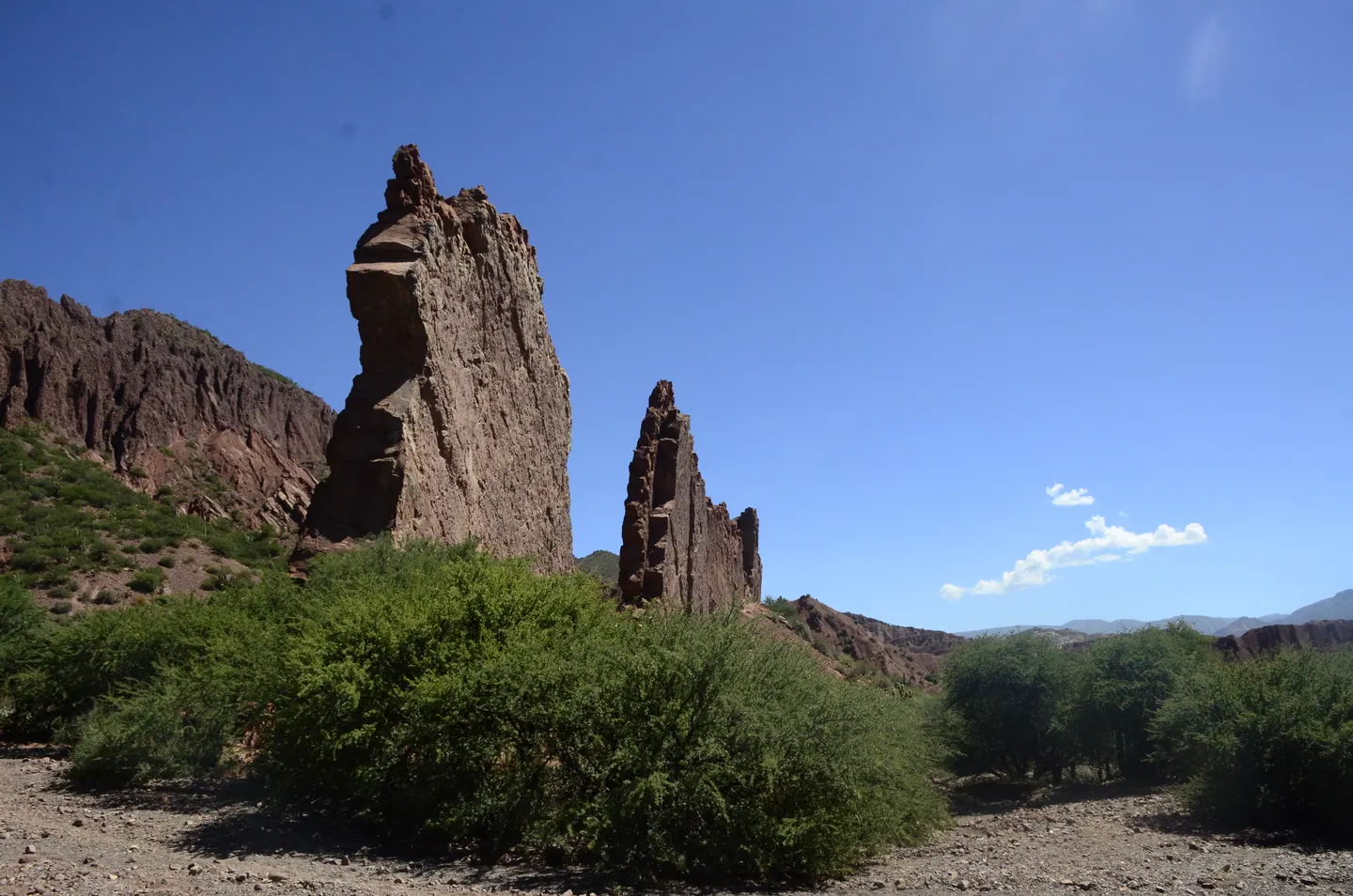
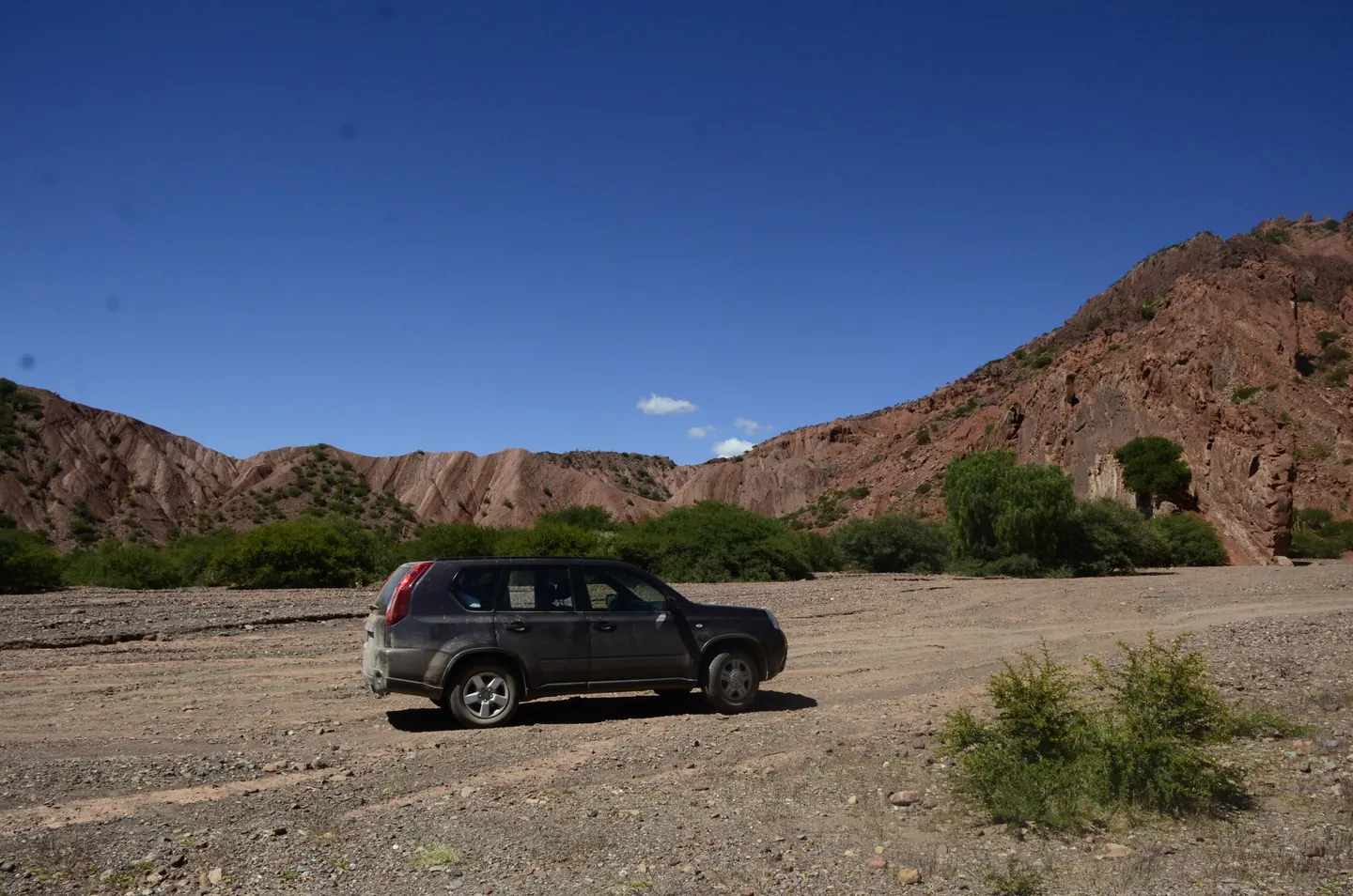
Morning in the desert on the edge of Tupiza.
We leave Tupiza for the heart of the desert.
On the way out we climb slowly and a beautiful landscape of sharp stone columns opens up: primeval and natural.
Most of the road isn’t too hard for a jeep, but on the other hand it’s winding and we aren’t making the pace we want. Add all the morning’s delays and we realise we won’t be reaching an inhabited village any time soon.
Despite the worries it’s hard to be miserable on a day like this. Off-road driving, distinctive landscape, alpacas in their natural place, and at every bend in the road the eyes enjoy something new.
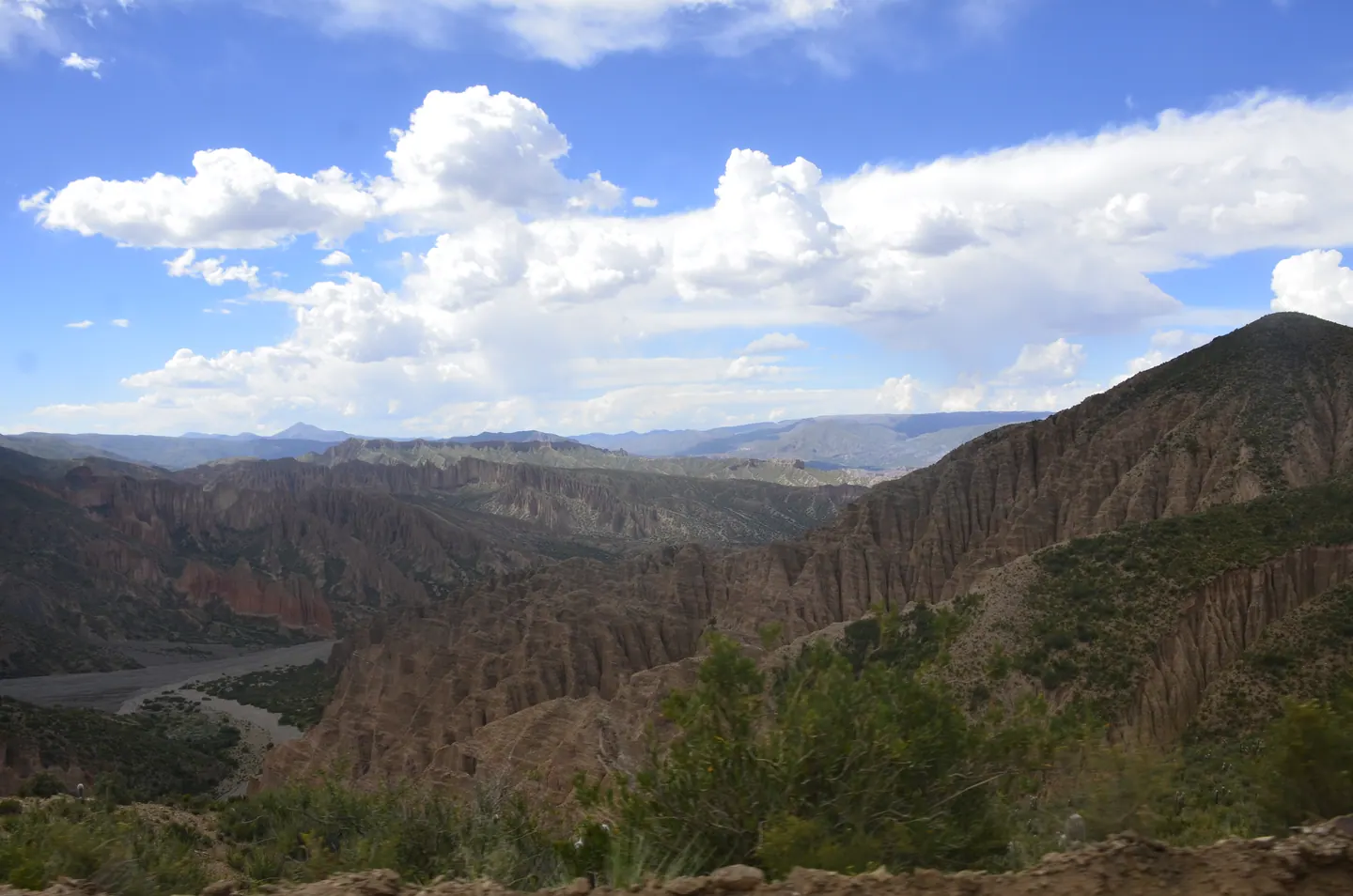
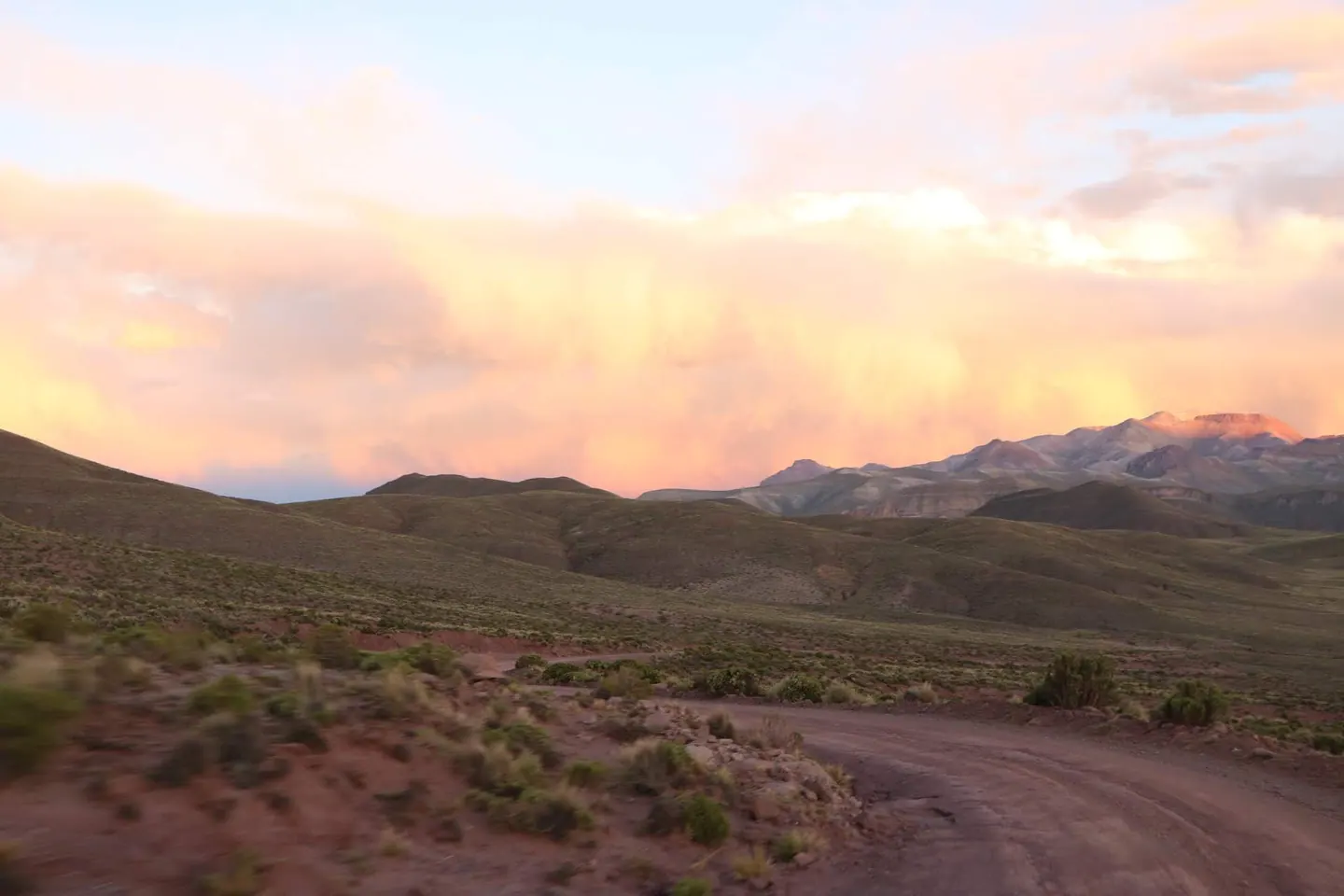
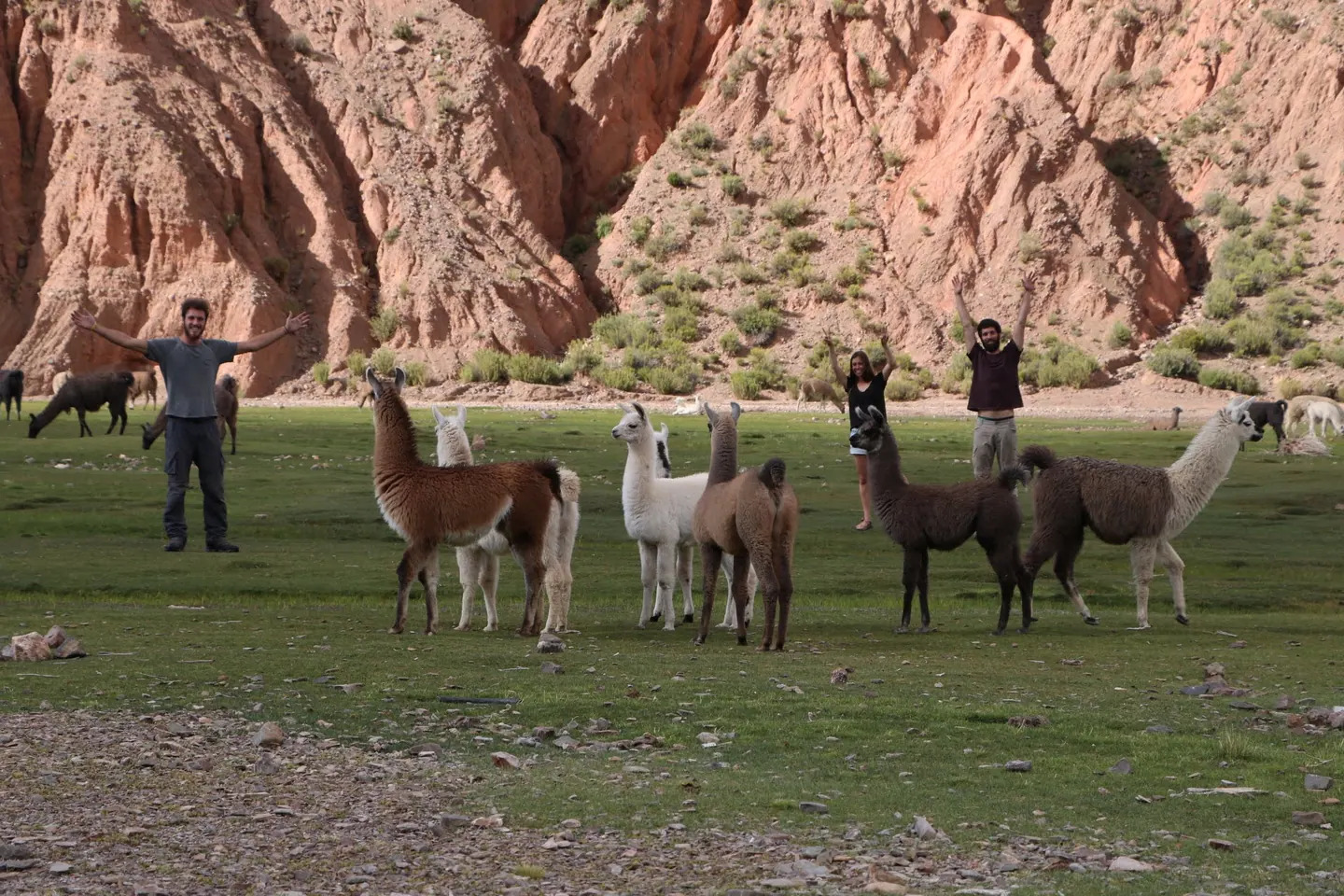
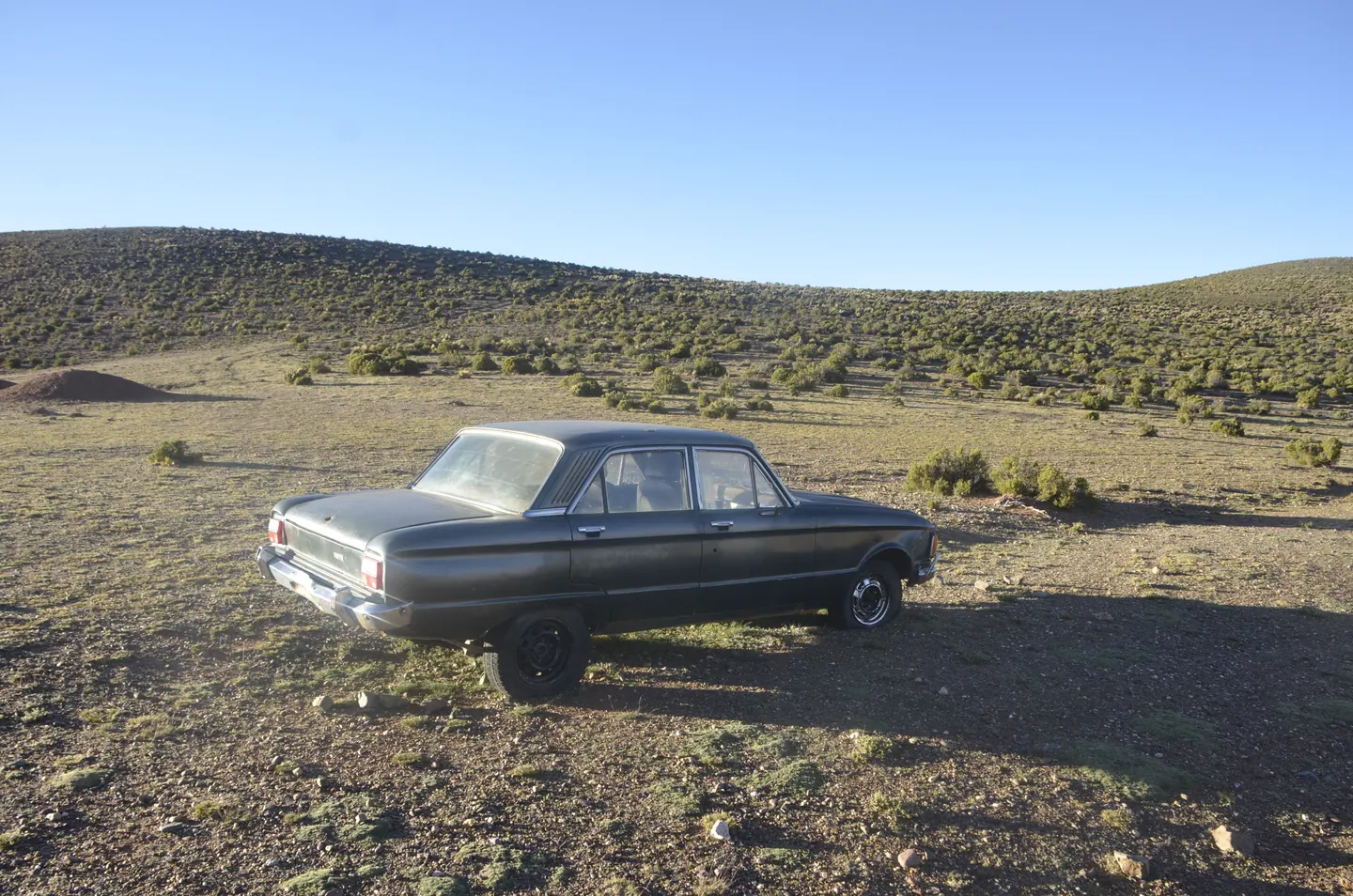
Along the way we pass several villages that are on the map, but we discover they don’t really exist in reality. Darkness falls and morale with it. We realise the morning’s delay wasn’t necessary, but there’s no time for post-mortems — we need to find somewhere to sleep.
The road twists a great deal, there’s no internet any more, and we have to gamble on which village will actually exist, because we’re never going to reach the original destination.
We gamble on San Pablo de Lípez.
We carry on driving slowly in the dark, hearing the car take a beating the whole way, but finally, late at night, the bet pays off. The little village exists after all.
Arriving in the village we drive down the street and a half that’s there, wondering whether there are living people in the place, and then we see a two-storey building with a sign reading — hostel. That we weren’t expecting.
When we go inside, after some fumbling, someone slightly dubious comes over, and we remember that before “hostel” became a trendy word it was a word with a real meaning: a place of lodging for people passing through. I don’t know what year the hostel was last renovated, but there’s a good chance I slept on the bed of an Inca messenger.
In any case we’re a long way from complaining. The hostel’s owner is nice and opens the kitchen for us, where we cook the hot dinner we’d been waiting for.
Towards evening, calming down a bit, we digest the day we’ve had. On one hand we saw extraordinary landscapes and genuinely got going; on the other we aren’t keeping to the schedule and we nearly didn’t reach anywhere normal to sleep.
On top of that, some of the group, me included, feel unwell because of the altitude change. Today we climbed to 4,400 metres above sea level, and with all the surrounding pressure it isn’t a successful recipe.
Despite how we feel, Shoham — whom no change really fazes — deploys his bartending skills and persuades us all to take Bolivia’s magic medicine: singani.
Singani is the authentic Bolivian spirit, and when we were at the market we were recommended to buy black singani, or, as we’ve called it ever since that evening in San Pablo de Lípez, jet fuel. Revolting alcohol, but maybe that’s what we needed to bring us back to reality a bit.
Despite the good atmosphere we go to sleep relatively early. We need to sleep well before another day in the Bolivian desert that we don’t know where it will lead us.
Morning of the fifth day
After a hard night, sweaty and very cold, during which I’d already decided halfway through that I couldn’t carry on, I wake up feeling much better than I expected. The rest of the group (except Shoham, of course) say they didn’t feel good either, but we all want to continue and feel relatively fine.
Before setting off we make a quick breakfast in the hostel’s dining room, and there something catches my eye.
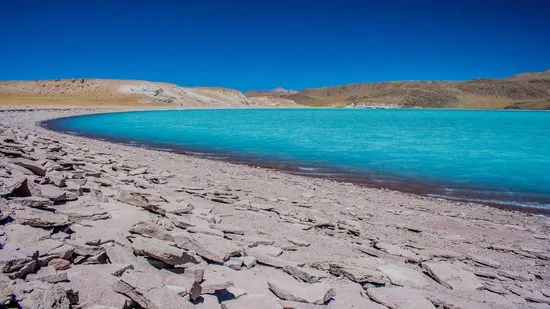
On one of the walls is a tourist poster, very old and faded, advertising the pearl of the southern Bolivian desert: Laguna Celeste.
I draw the others’ attention to it and we open Maps.me for the day’s route planning.
According to the original route we should carry on along the track that leads straight to our destination, Quetena Chico, which is also the gateway to the national park.
But as we look for the lagoon from the poster, we find there’s a secondary track leading to the same place via a detour that would take us three to four hours longer, but which passes several lagoons in every colour you can think of: yellow, red, green, and of course the turquoise lagoon.
Here we’re at a real crossroads. We already saw yesterday that our jeep and our time planning aren’t things you can predict. On the other hand, we’ve been through so much and we want to enjoy the freedom we worked so hard to get.
Well, you can see where this is going, can’t you? The lagoon track, obviously.
We set off relatively early and leave the main track for the secondary one.
Calling the secondary track a track is definitely a compliment. It’s more like an ancient marking of a path from Inca times.
Our jeep, carrying five people and gear, is definitely struggling and taking blows from every direction, but slowly and carefully we manage to make progress and reach the first lagoon.
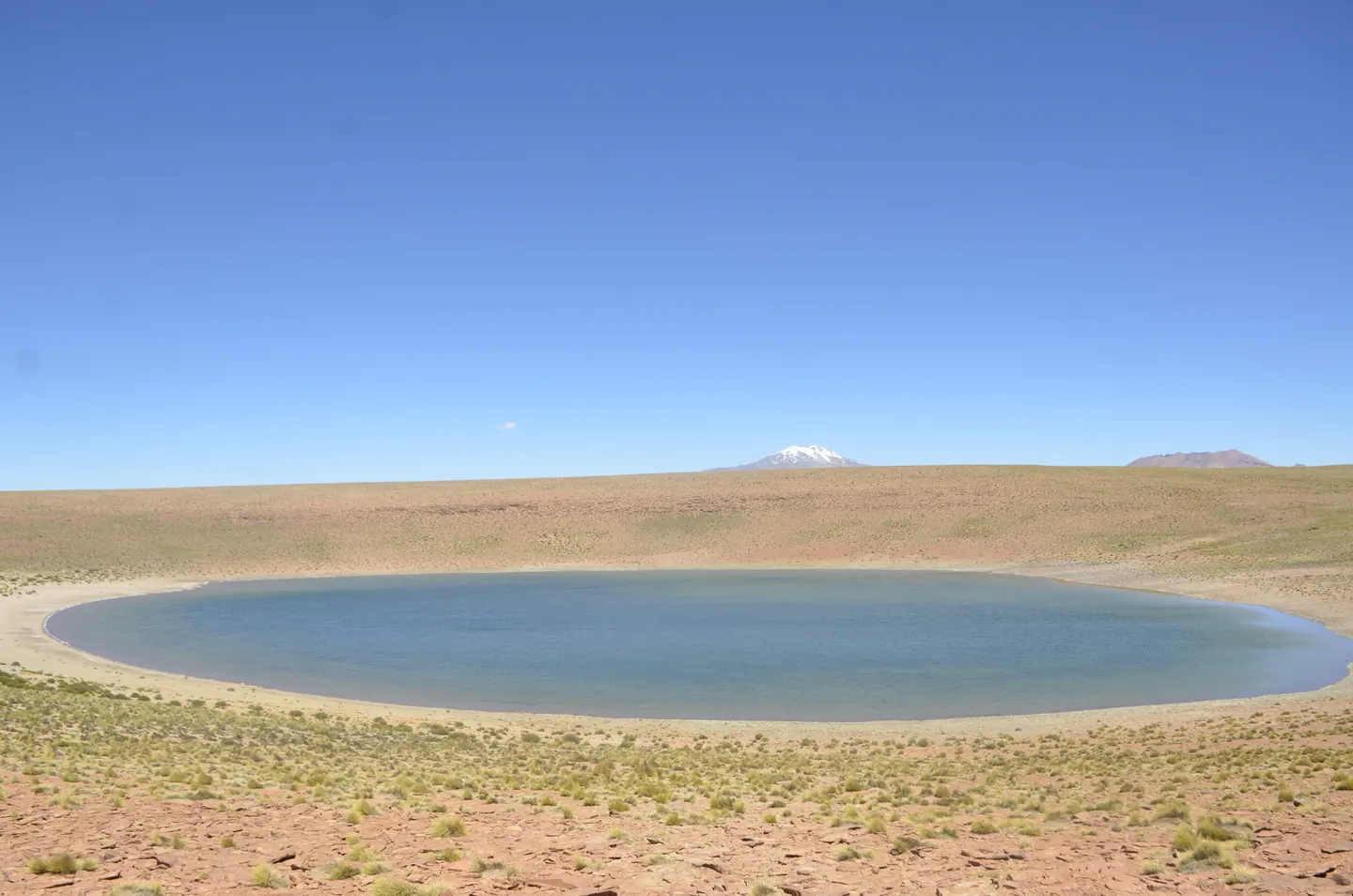
The first lagoon isn’t especially exciting, but it’s certainly good to see a sign of what’s coming after an exhausting few hours’ drive.
We use the moment for a quick lunch and a brew, go down to the lagoon for a fast photo, and carry on.
After the lagoon the terrain becomes especially hard and the drive turns painful and slow, and after a kilometre the bang we’d feared arrives: the sound of a puncture.
We take a long breath and get out, and then we realise this puncture is much more than a puncture. It’s fate.
During that kilometre we’d driven, the rear door hadn’t been properly closed and had opened. Bottles of spirits broke and, most importantly, Einav’s bag had fallen out on the way.
Every additional kilometre we’d have carried on in those conditions takes long minutes — and who knows whether we’d even have worked out where the bag had fallen.
Back on the ground, we split into two groups. Neri and Einav go to find the lost goods while we change the puncture.
Despite our great luck, we remember we’re left with one spare wheel, which has already been repaired after a puncture. Not the thing you’d want to rely on in the heart of a rocky, unforgiving desert.
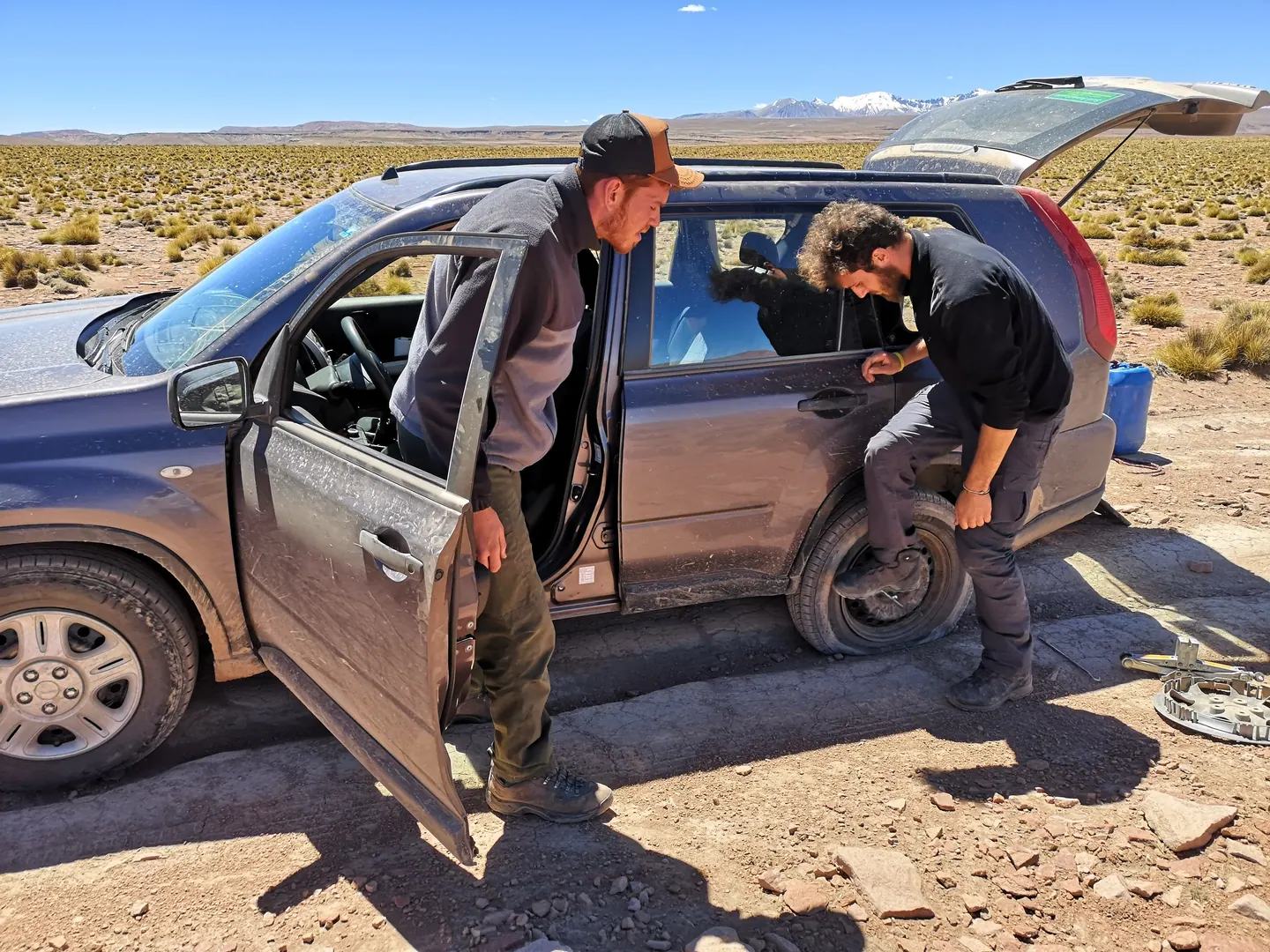
Back to business. We carry on driving, gear intact, despite the painful loss of a bottle of Ballantine’s and one of Jack Daniel’s.
Over the next hours the facial muscles worked hard, between moments of wincing at every blow the car takes from all sides, and moments of smiling and wonder at the extraordinary lagoons along the way.
Between the lagoons we also have an extraordinary moment of humanity. We reach a tiny village of stone houses, one of the only ones on the road that hasn’t been abandoned. With Israeli nerve we knock on one of the doors and find an old woman who speaks half Quechua (the ancient Inca language) and half Spanish.
Eventually she understands that we want food and offers us empanadas that they make.
And so we find ourselves inside the little stone house, making empanadas together with the woman and her husband out of alpaca meat, and learning a few words of Quechua along the way.
On the way out of the hut, one of the village women, who’d heard about the largest wave of tourists seen in years, comes to us with things she knits from alpaca hide, and as a gesture and a memento of the moment I buy a wool hat from her.
With the dubious empanadas in hand we carry on our way through the desert. The many delays and the slow driving sadly don’t allow us many stops, and we see Laguna Celeste too, but only from a distance. We didn’t meet the day’s target, but the challenging road and the sense of complete disconnection are definitely the story of the day.
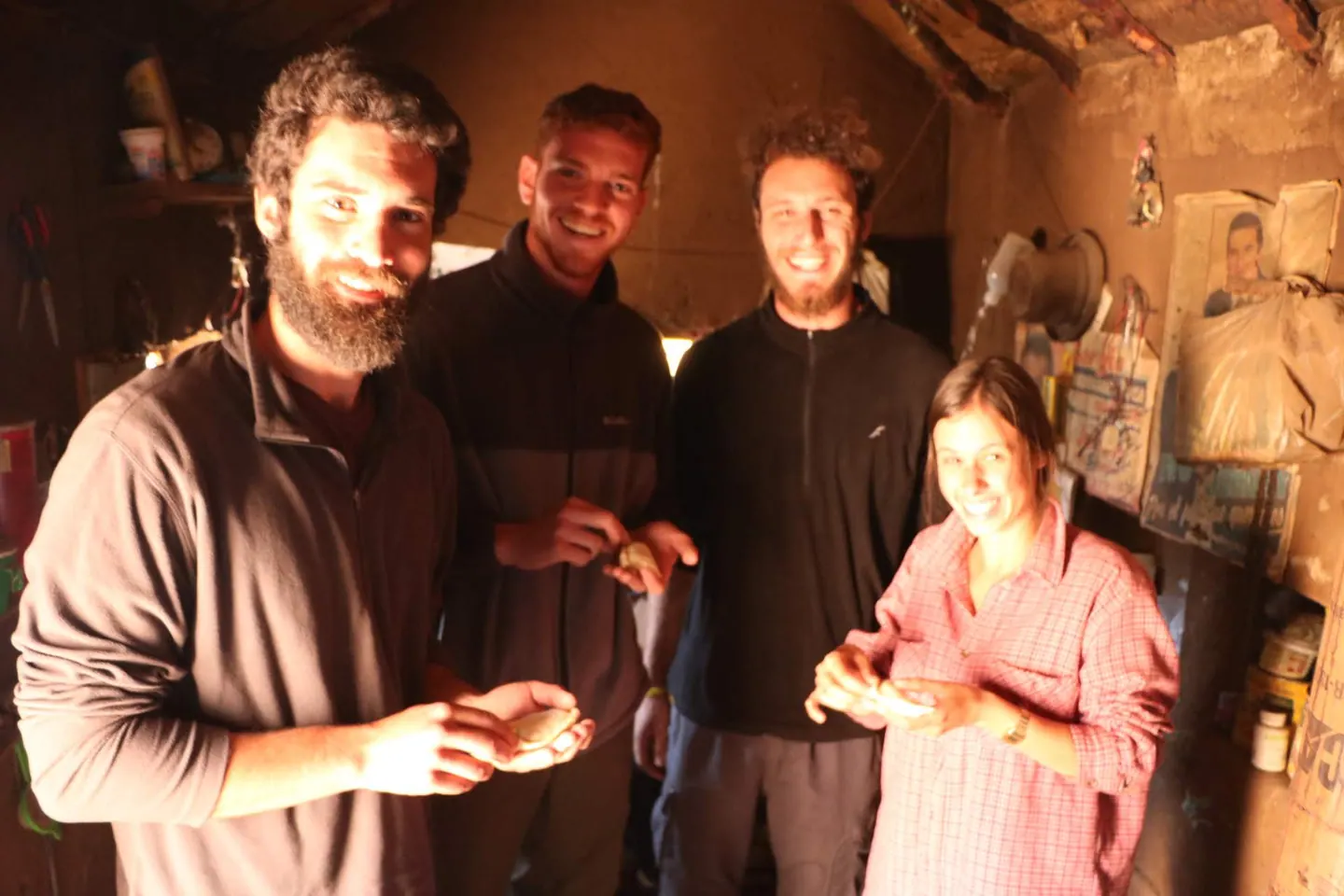
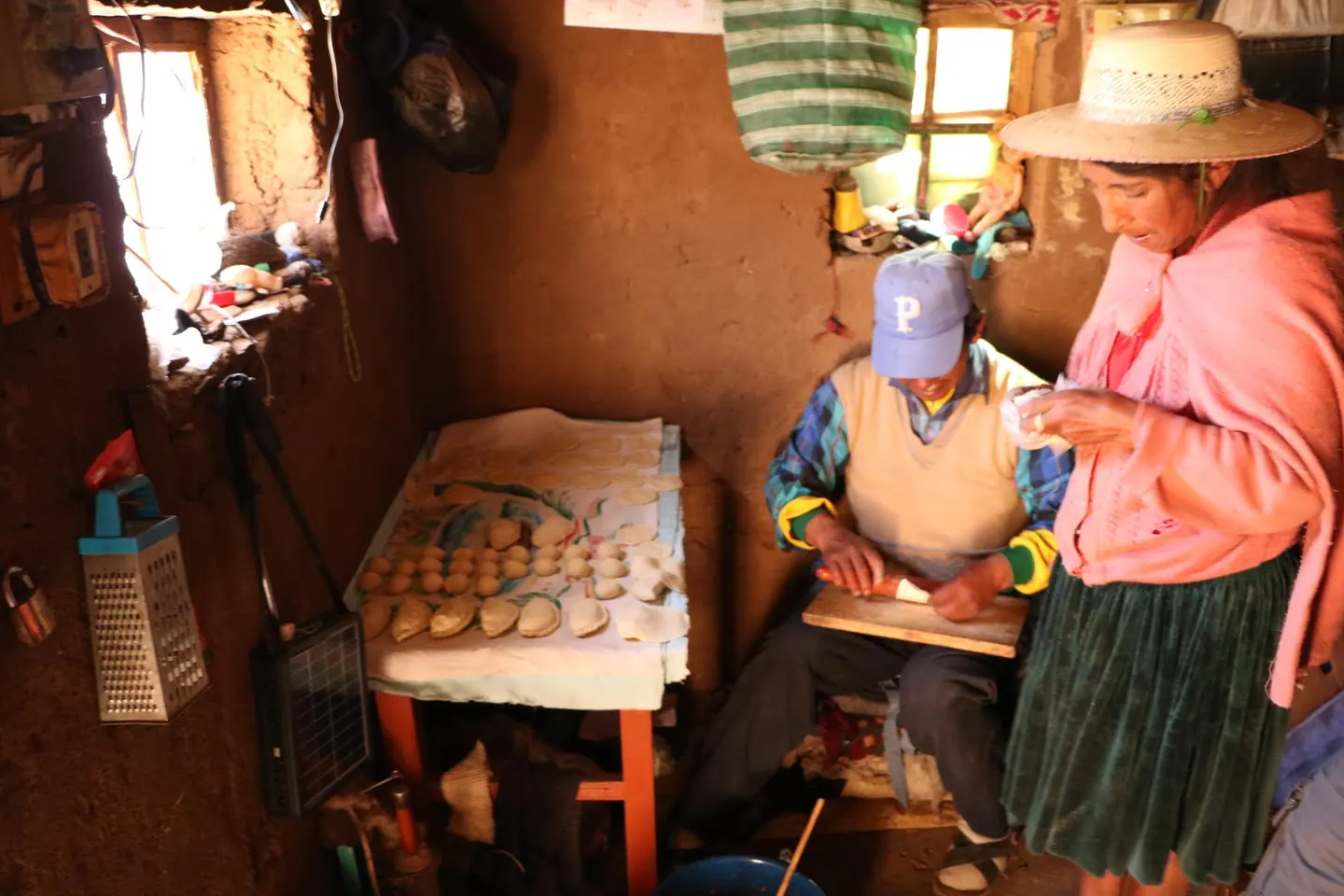
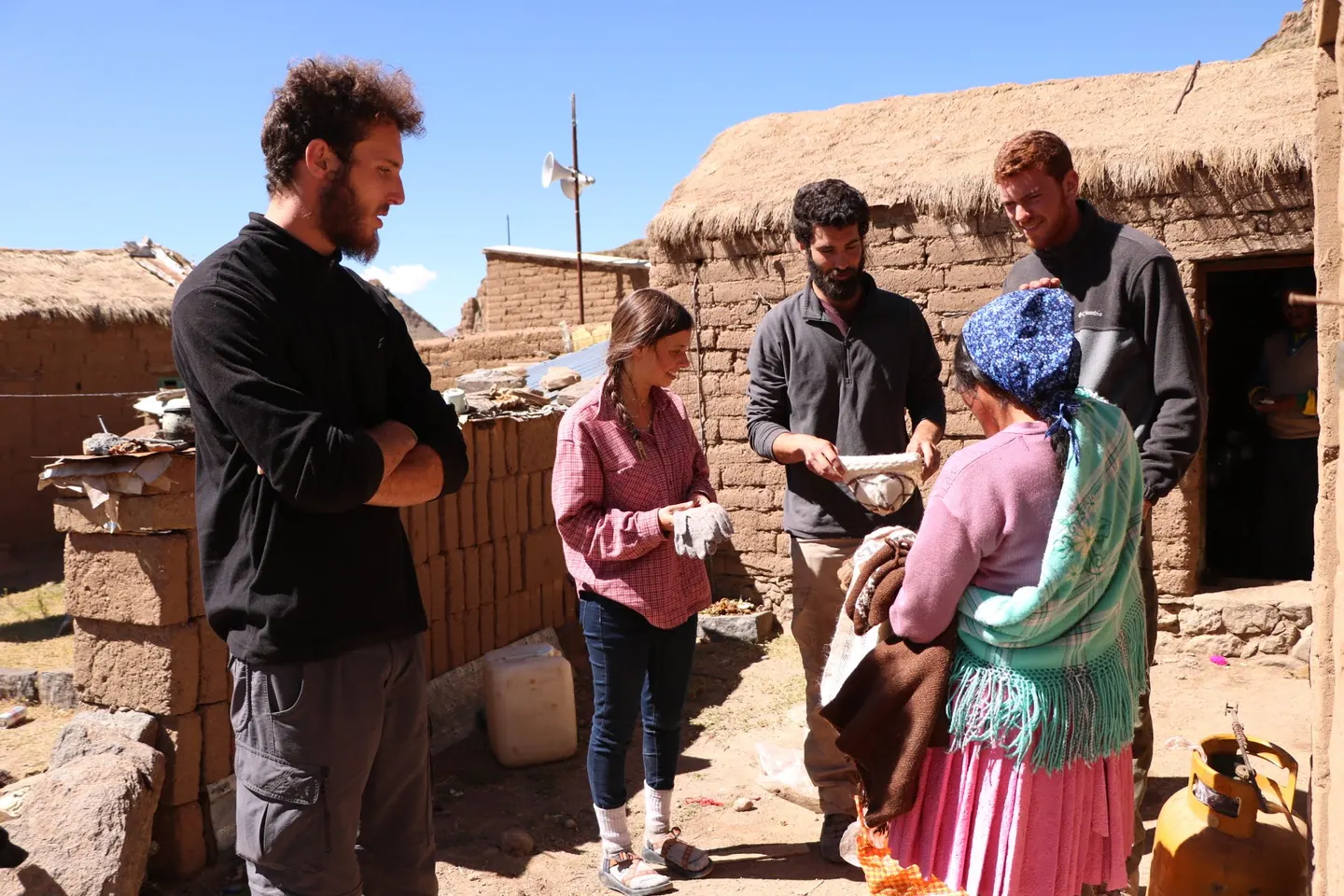
The authentic visit to the remote village.
Towards sunset we reach the national park’s gate, the first sign of civilisation.
The track from here is far more orderly. The vehicle has come through the hard part. We carry on and reach the hot springs at Termas de Polques.
Beside the hot springs there are several places to stay where jeeps from the organised tours out of Uyuni are already parked. We go into the largest of them and realise we’ve definitively rejoined the big trip: a table full of Israelis waiting for dinner.
They ask which tour we’re on and we laugh. Try explaining to them that a few hours ago you were in a remote village making empanadas with an old woman in Quechua.
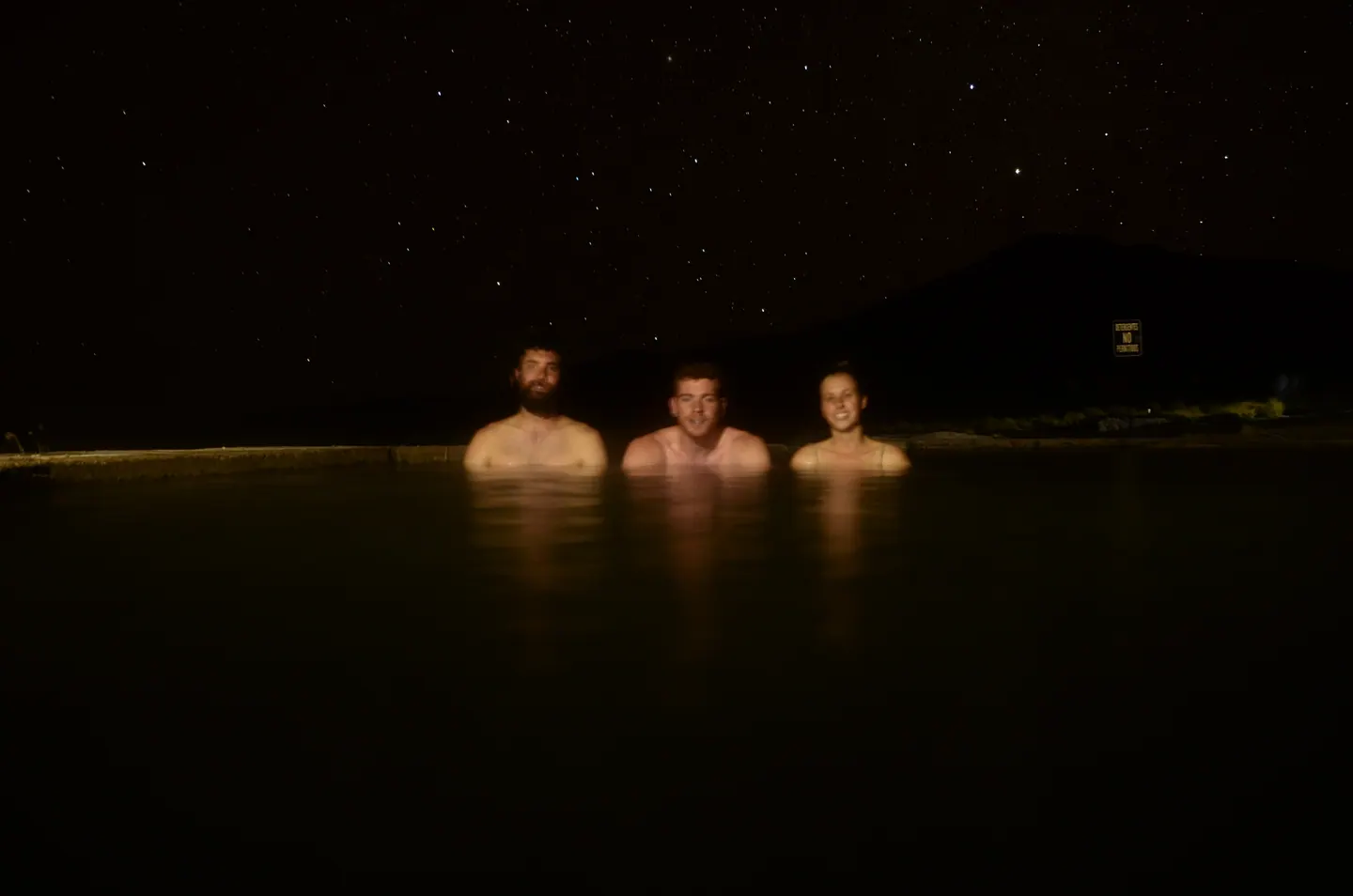
Towards night, after a short rest, we head out to the hot springs. An extraordinary combination: a desert with almost no lights around reveals the whole Milky Way and the stars in their full glory, while at the same time the body enjoys hot springs from the belly of the earth. Exactly what we needed after a nerve-shredding day.
We go back to the hostel but don’t survive awake for long and cut straight to sleep.
Morning of the sixth day
I decide to make the most of the hot springs again, get up early and go to watch the sunrise. Flamingos join the extraordinary sight of the sunrise and create a perfect picture.
Half an hour later the organised tours start waking up too and join the hot springs. It’s crowded for a short while, but I see the guides calling the travellers back to the jeeps, and in those moments I appreciate more than ever the decision to do the trip independently, with no time limit. Later in the day I’d discover how much I needed that shot of motivation — because although we’d returned to civilisation, the real adventure was still ahead of us.
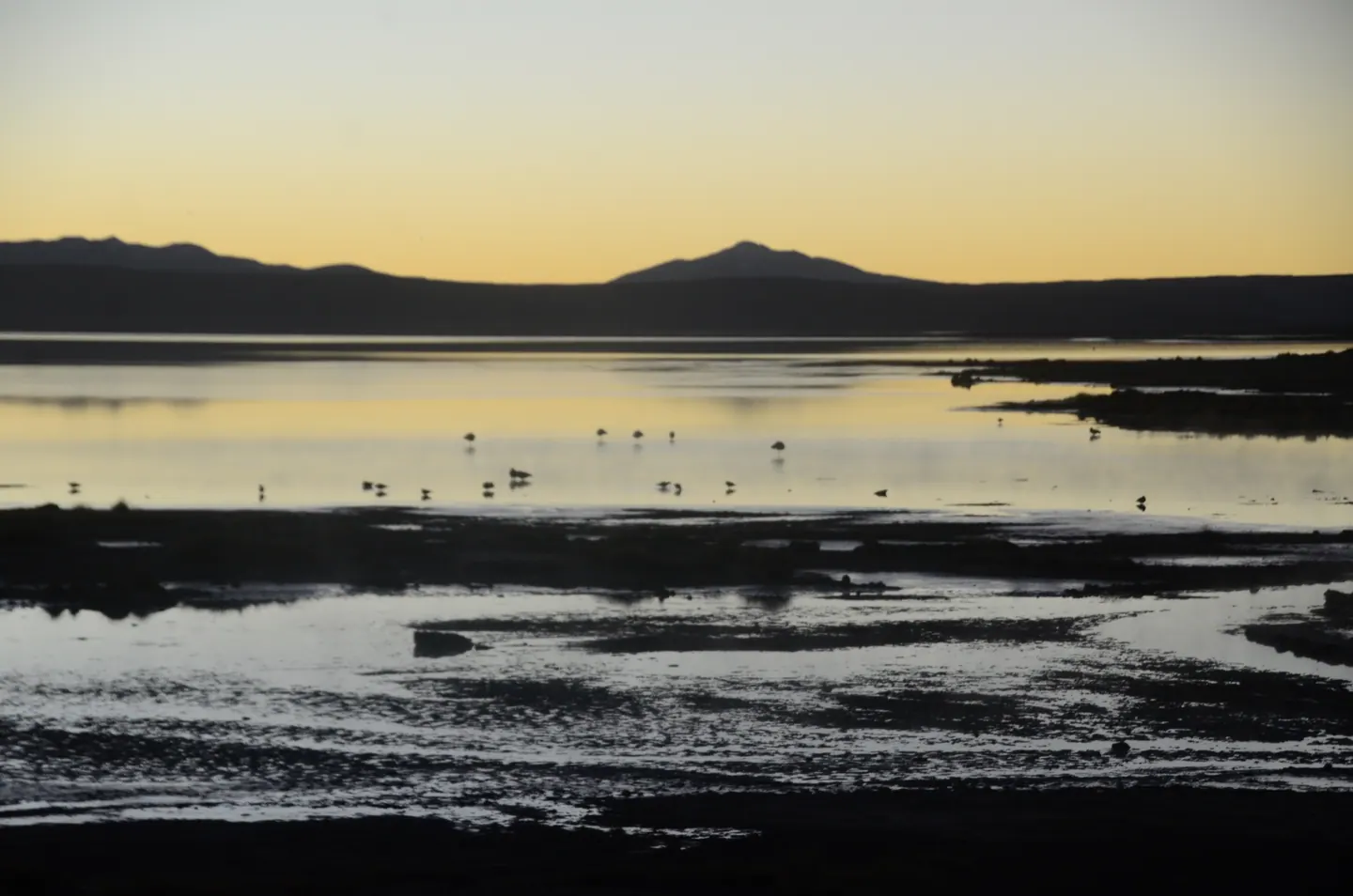
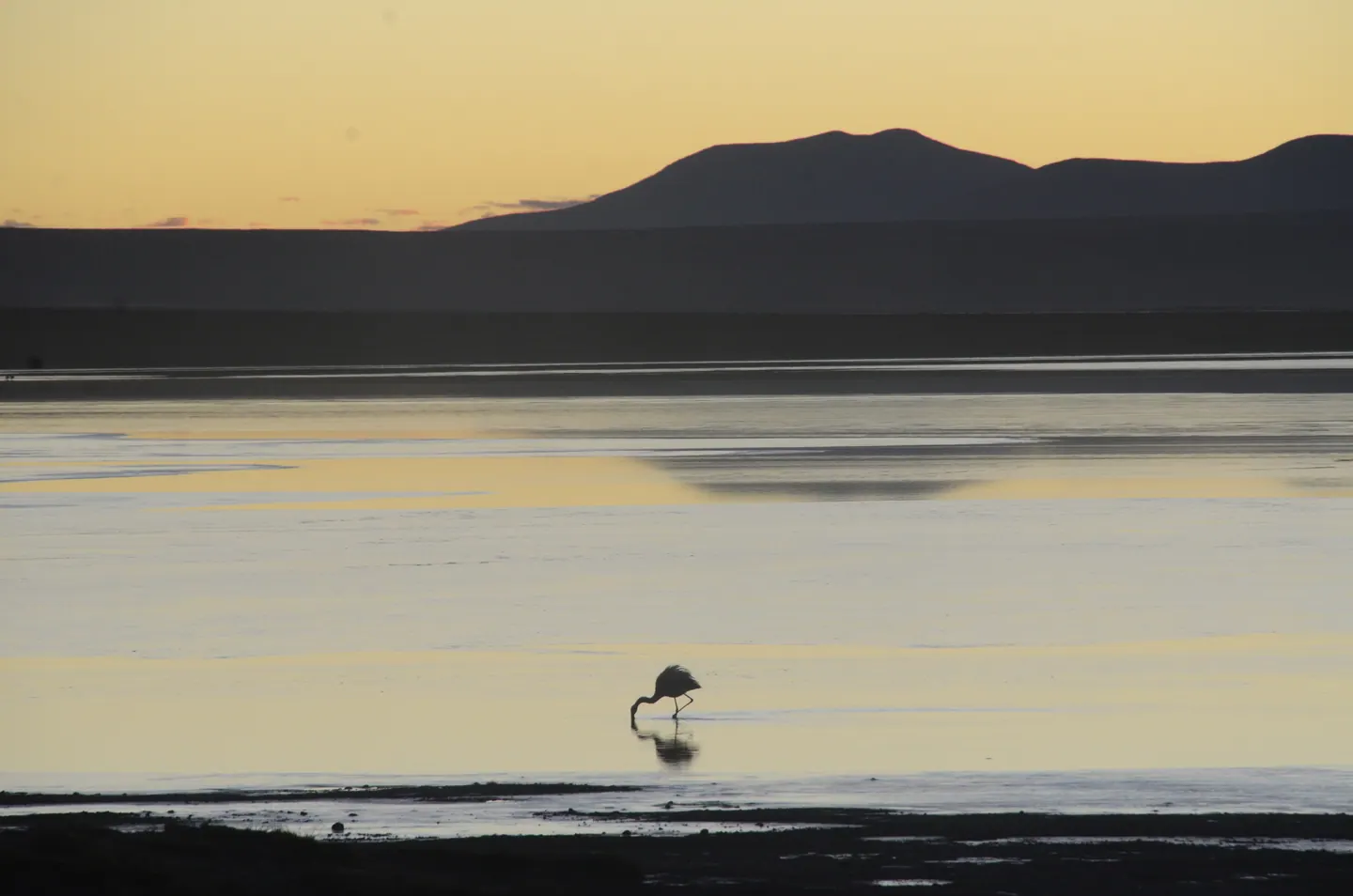
Sunrise at the hot springs.
The others wake up and we get back in the jeep. Today the plan holds the park’s main attractions, the same ones the organised tours do. The first destination is the geysers at Sol de Mañana.
On the way there Maps.me confuses us and we arrive at an iron gate with a booth beside it. We’re a little surprised but think it’s a checkpoint of the Bolivian tourism ministry. Nobody comes over to us and we get out to see what the story is, and to our surprise the booth is open and we can see keys lying on the table. This trip stopped surprising us long ago, and we take the keys and open the gate for ourselves.
After a kilometre of driving and factory signs we finally realise we’re not on the right road — but hey, at least we can tick off breaking into a factory in Bolivia.
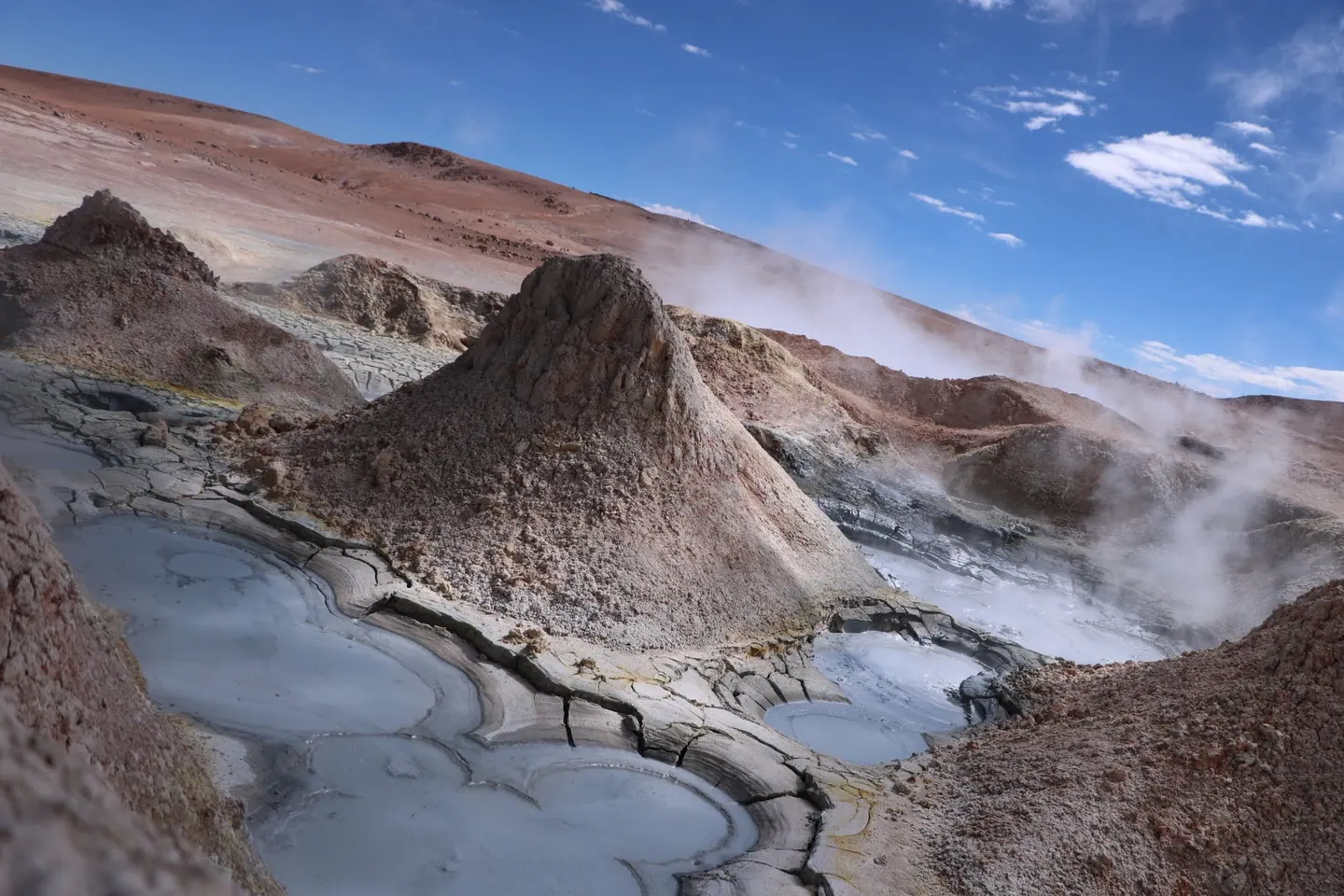
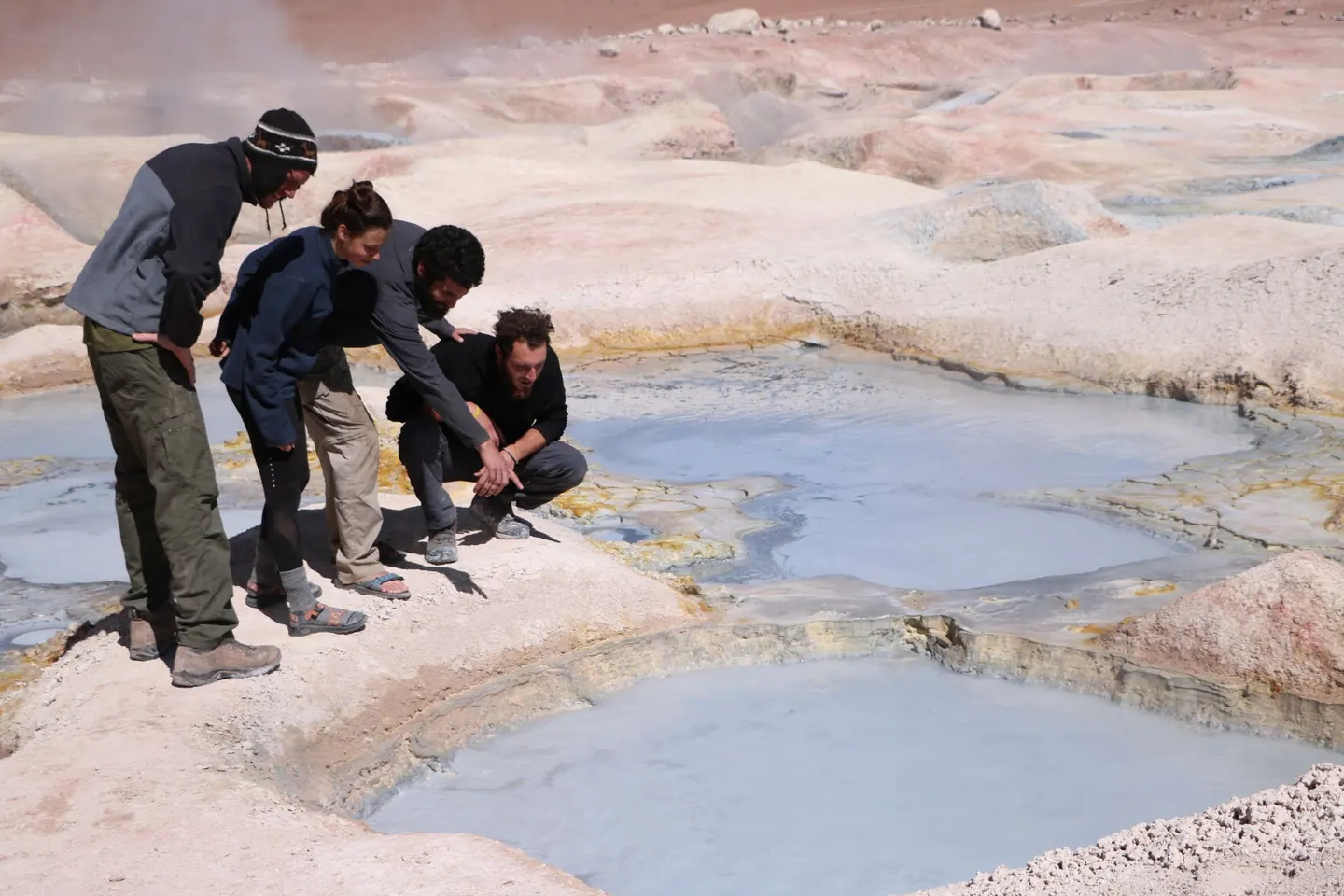
We get back on route, follow tourist jeeps and reach the geysers. A distinctive and powerful place.
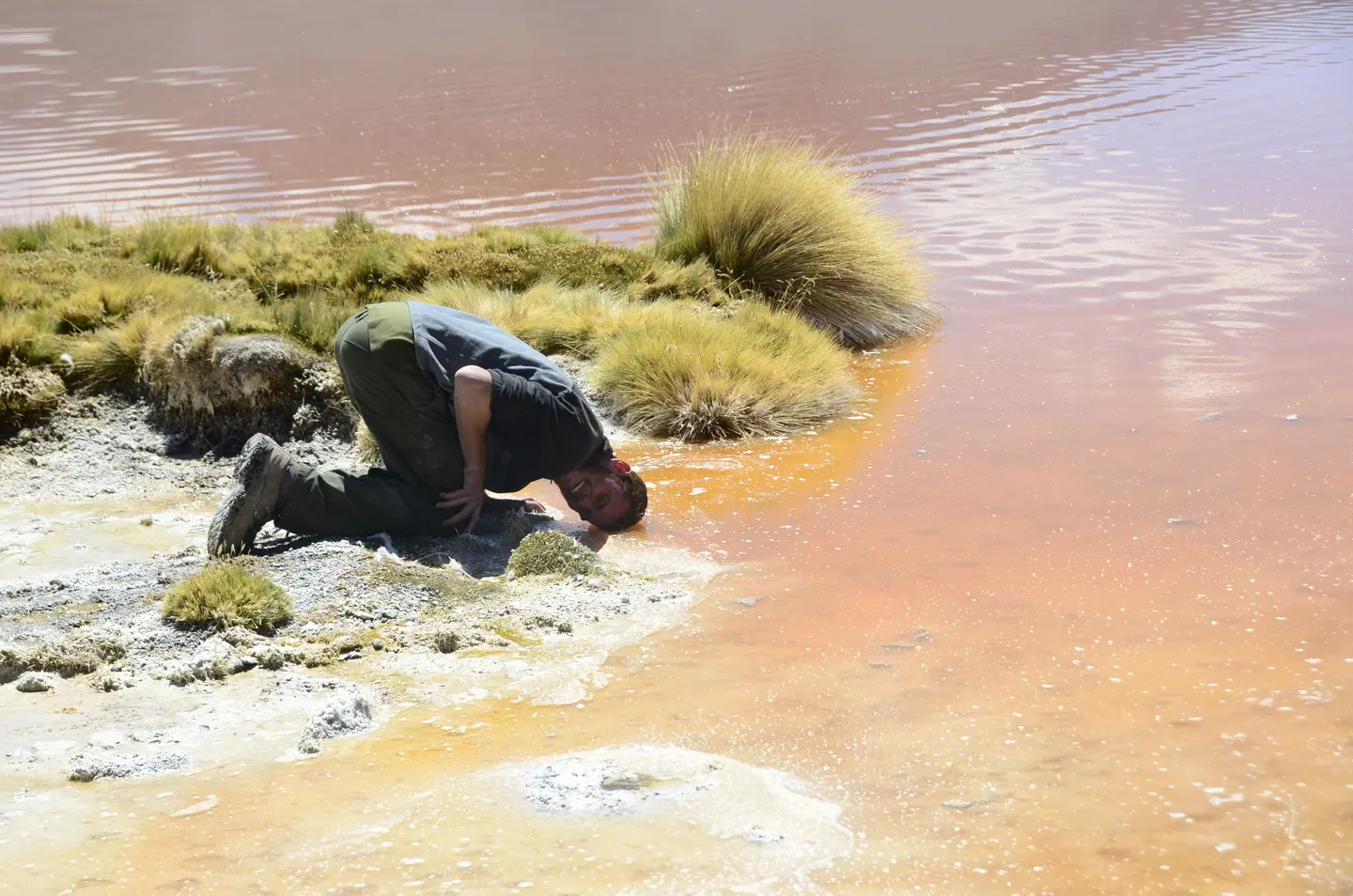
From the geysers we carry on along the tourist route and reach Laguna Colorada, the red lagoon: a beautiful place that takes on an interesting shade from the combination of flamingos and the red-orange water. I use the moment for an amusing photo comparing the colour of the water with the colour of my hair.
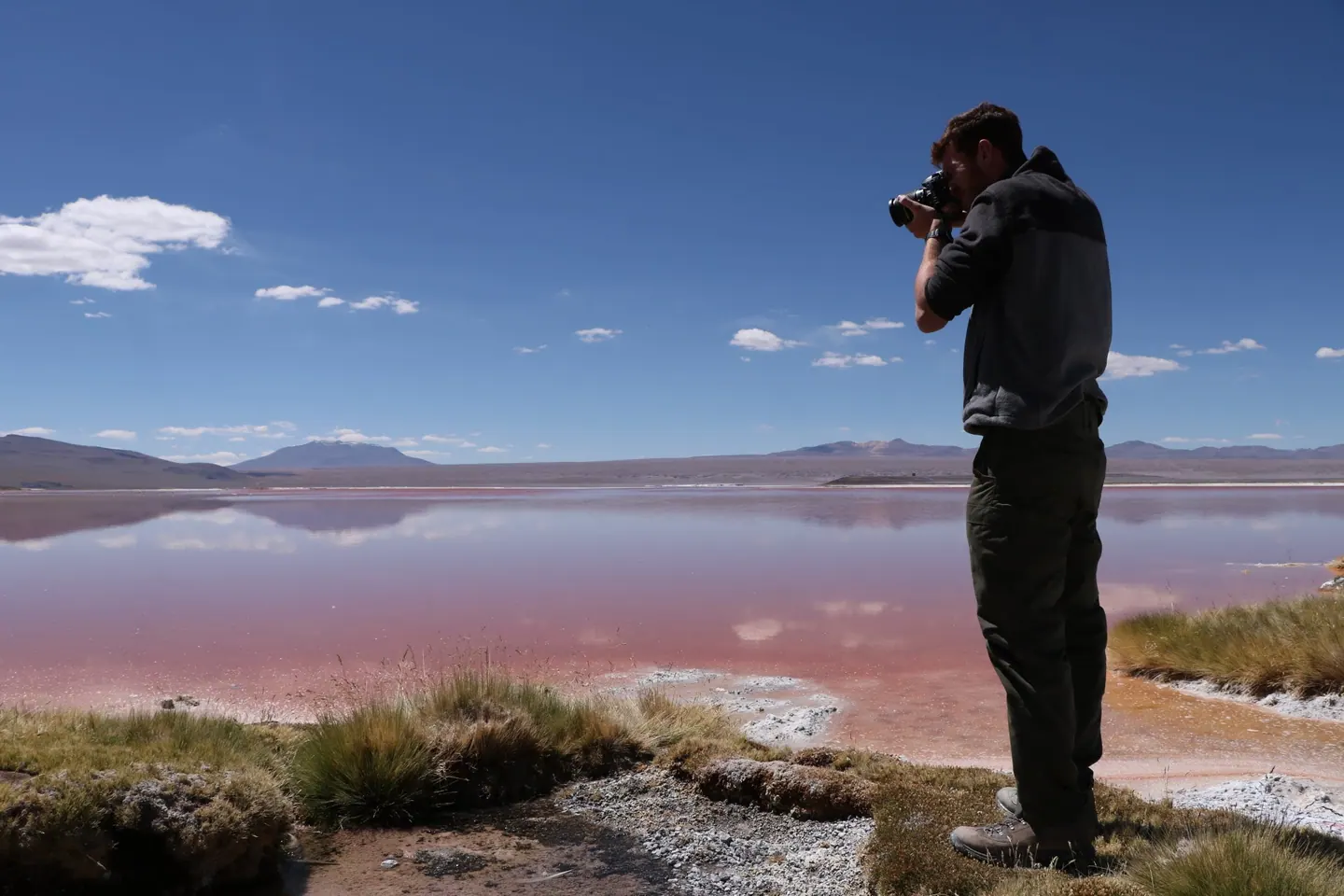
After Laguna Colorada we see we’re finally on schedule, so we decide to carry on south and have lunch at a nice place called the Stone Tree — a distinctive rock formation shaped by the winds over the years into a tree. The road there takes us back to the shaking of the previous days and we take blows from every direction again, and after an hour’s drive we reach the long-awaited spot.
A moment of contentment, enjoying nature, realising the rock formation is nice but is entirely an attempt to draw tourists with a well-developed imagination.
But apparently on our journey there isn’t a dull moment, and after a few minutes of sitting and starting to organise the meal, Raz draws my attention to an enormous stain under the engine. I look and can’t believe it: our engine oil is pouring out fast through a large hole made by one of the rocks on the road. Within a minute we’re all back in the car, starting a race against time.
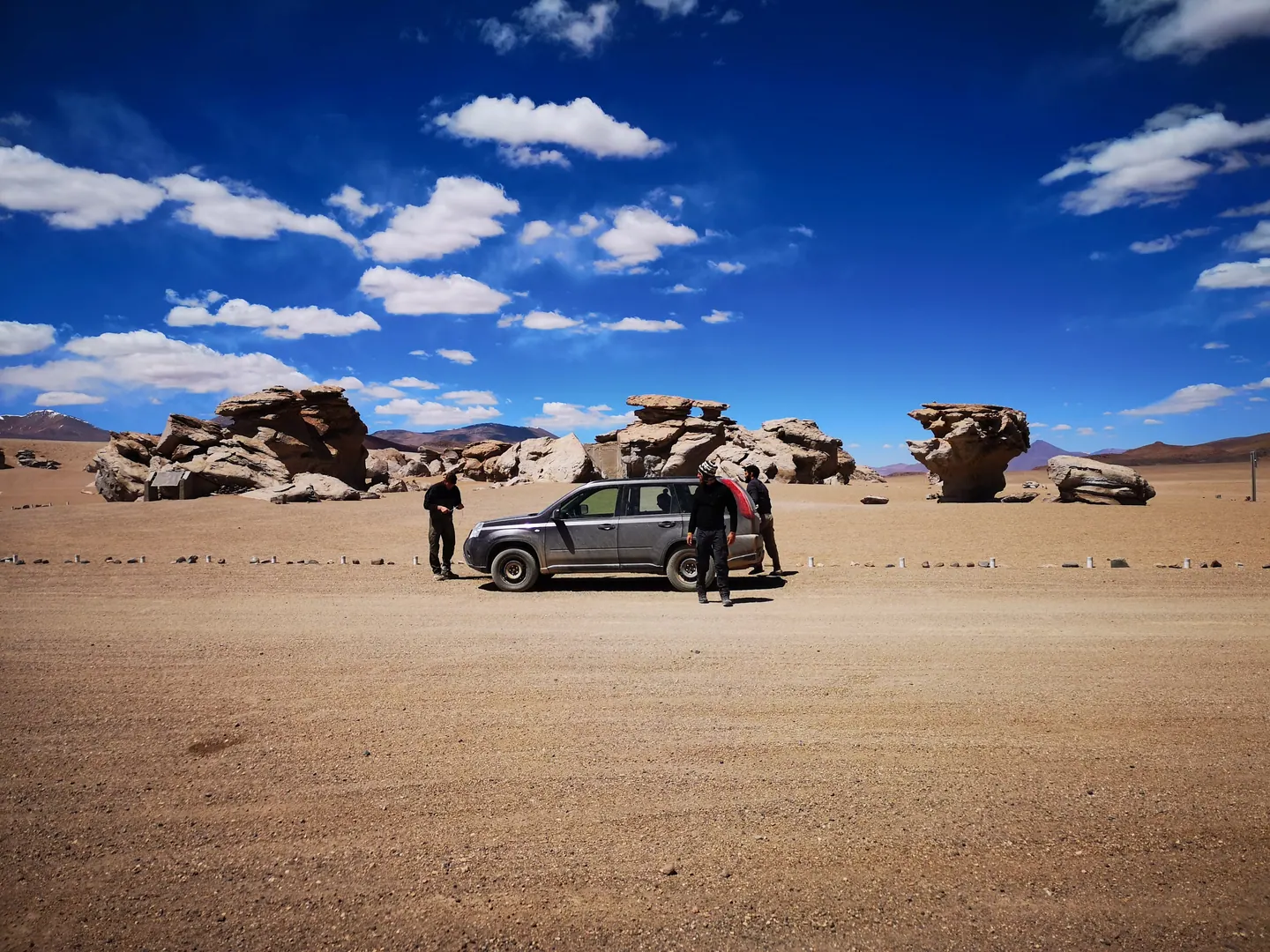
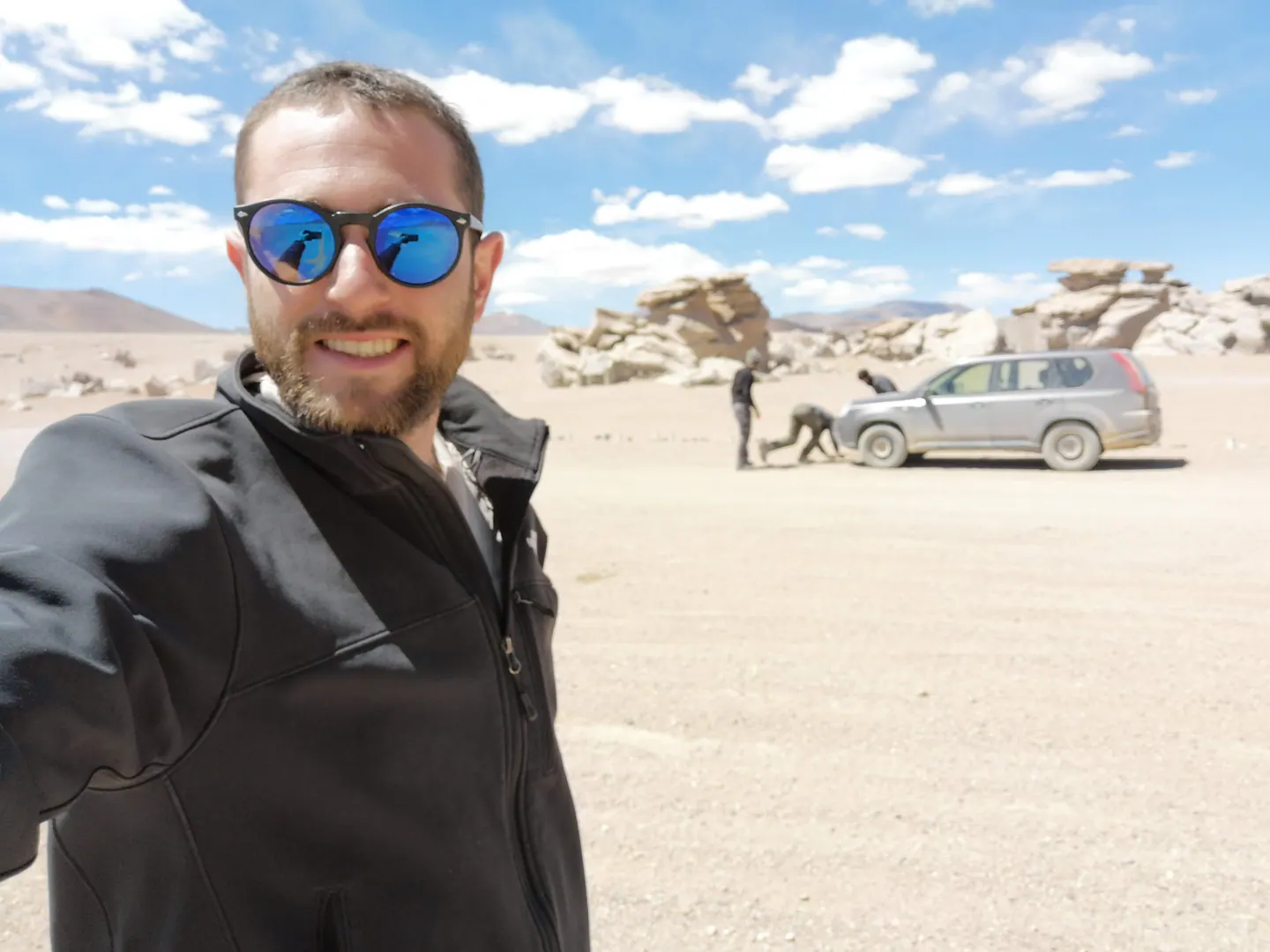
Thanks to Neri, who made sure to document us while we were under the vehicle.
At the Stone Tree that day there were no other tourists, and we have almost an hour’s drive back to the track with the other travellers’ jeeps. The engine temperature climbs and climbs. On the way we see a local jeep whose driver tells us that further along the track there’s a shop selling vehicle supplies.
We reach the place after half an hour and buy several containers at an extortionate price, but there aren’t really any options.
We top up the engine oil, but we have no way of stopping the bleeding. We have to reach a village or somewhere with a garage quickly.
We carry on. Still no sign of a tourist jeep.
The engine temperature climbs again and we top up the oil once more with the extra containers we bought, to survive a few more kilometres.
After the second top-up there are strange noises, but we’re in a race against time and don’t attach importance to it, and carry on driving.
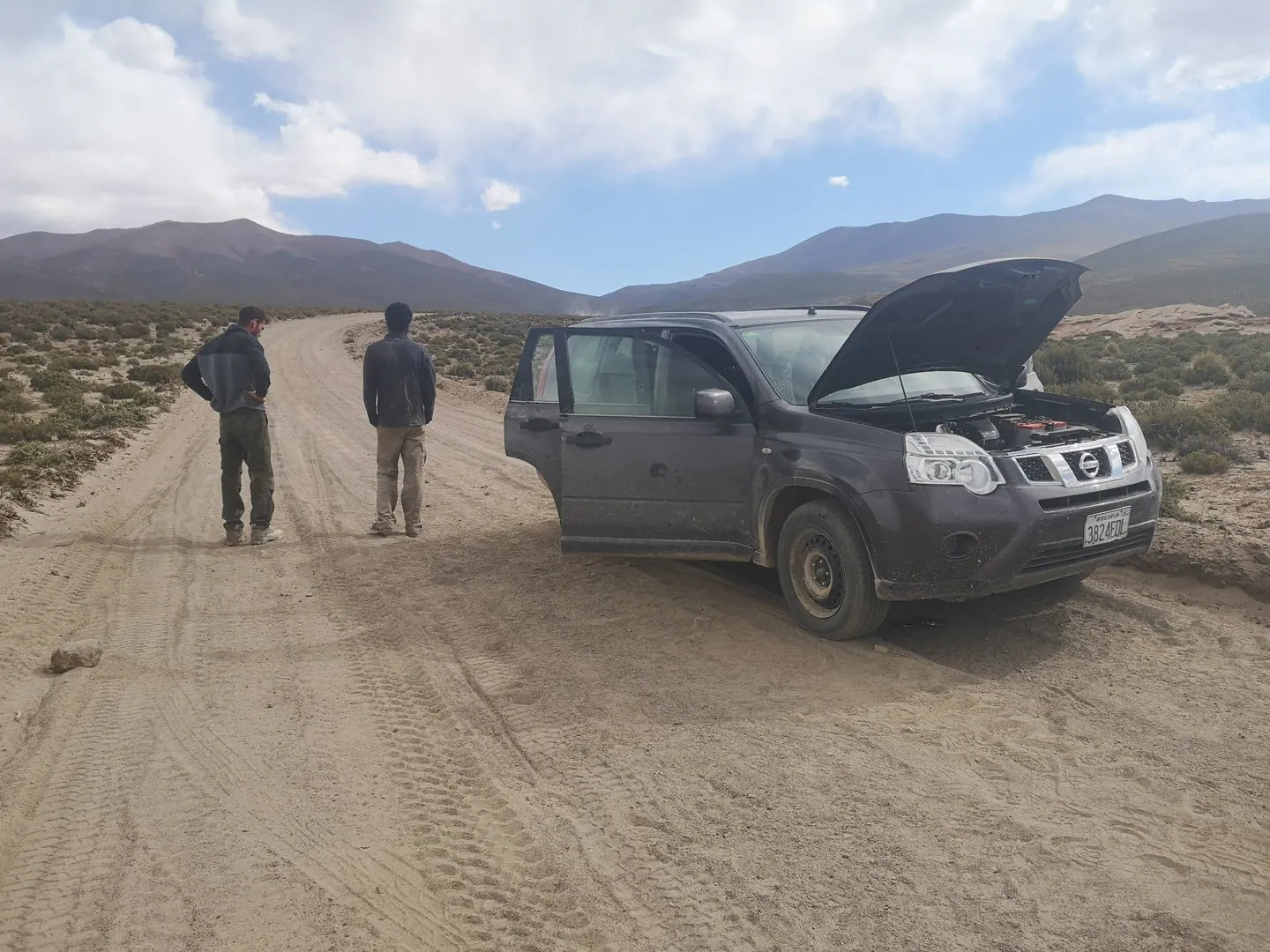
After only a few kilometres, far fewer than after the first top-up, we can no longer move.
We open the bonnet and realise that on the second top-up, Raz and I hadn’t closed the cap.
That’s it. Now we’re genuinely stuck. A feeling of anger and frustration, and not too much hope.
We decide to use the time for lunch, because who knows when we’ll need to pack up or make decisions. After a short while a convoy of jeeps with tourists passes. We explain the situation to them and they tell us to wait for a jeep coming in an hour — a white jeep, which will be able to tow us, and which has the most professional and experienced guide.
The knight on the white horse, jeep edition.
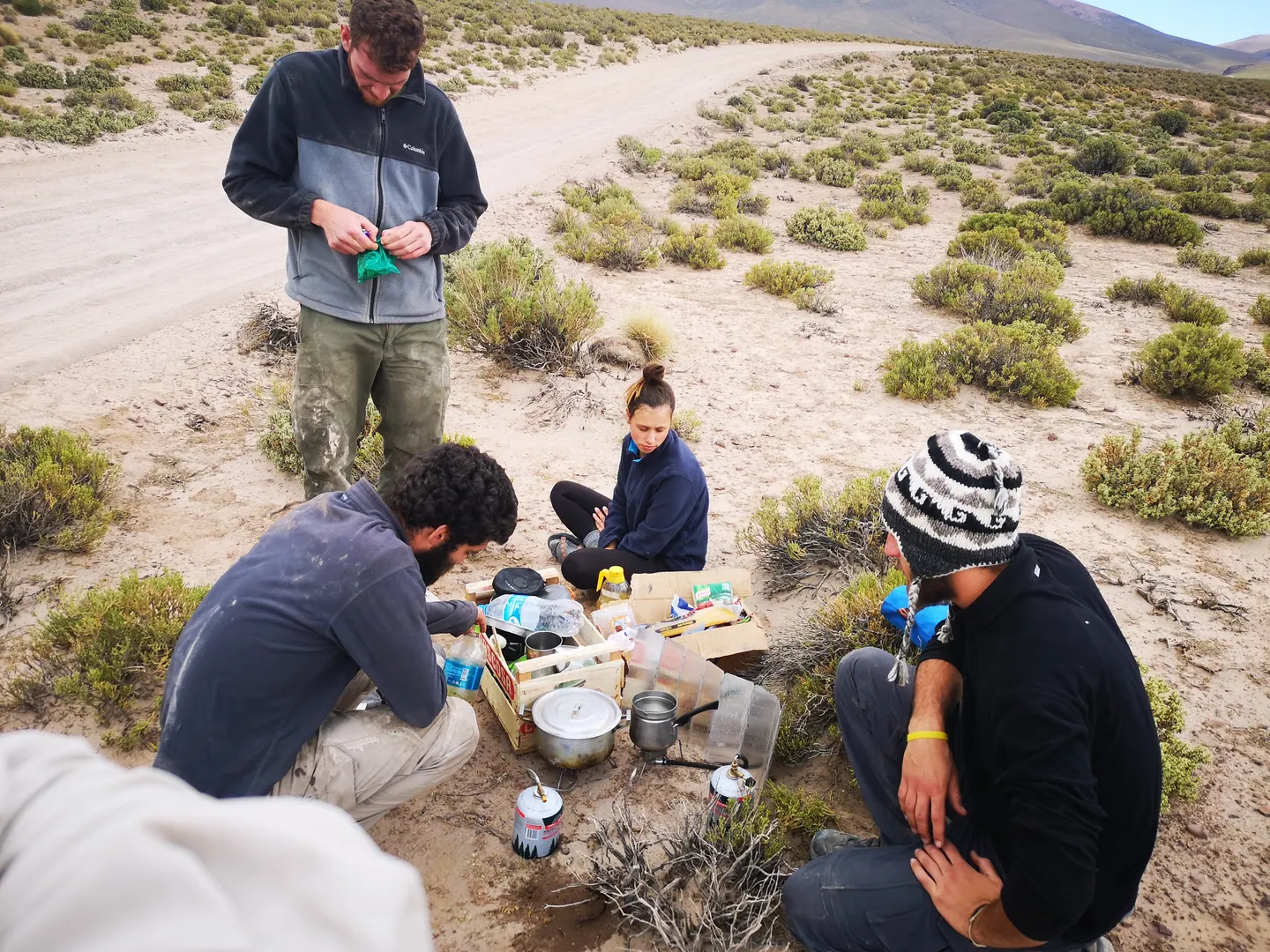
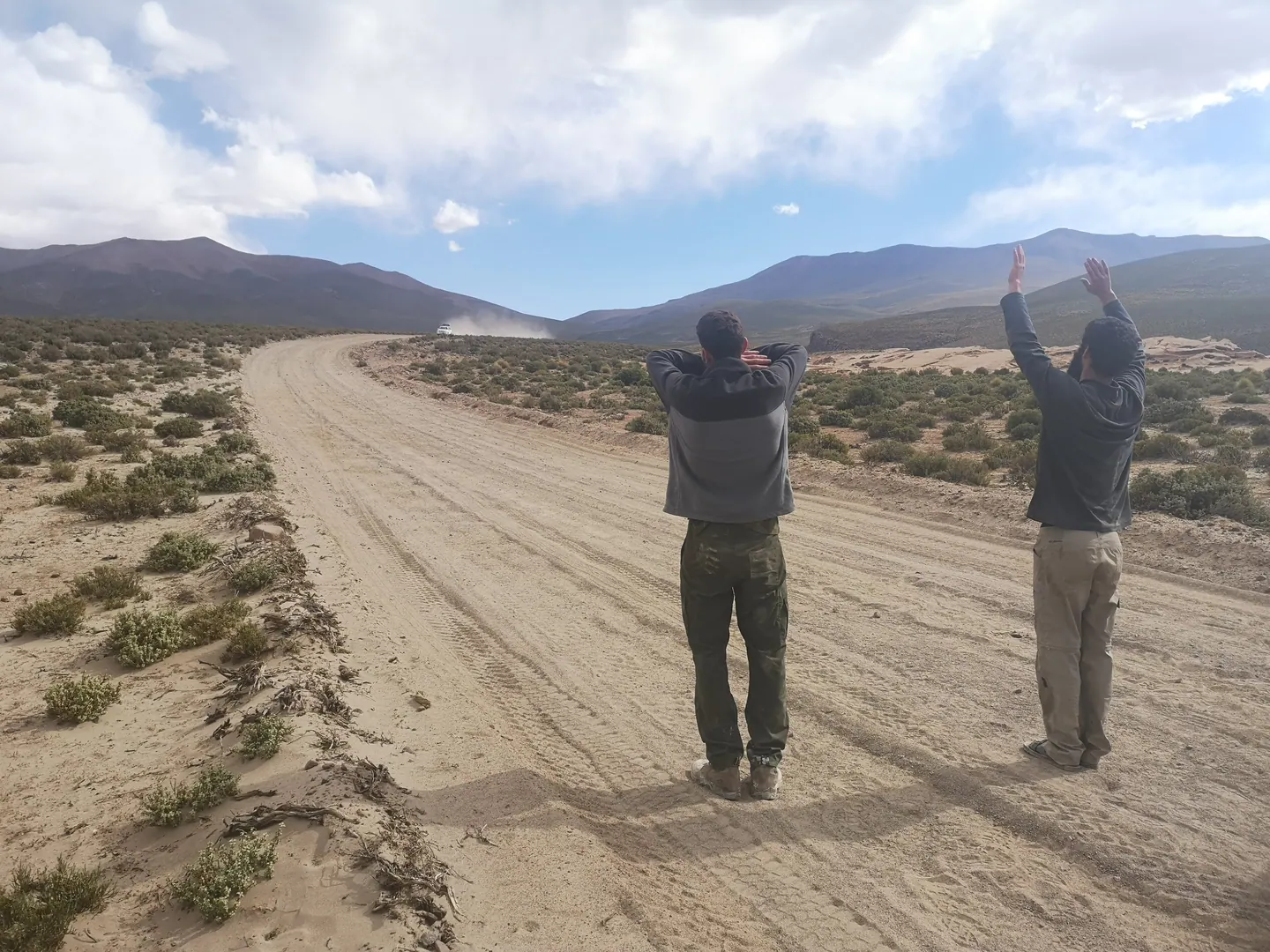
Finally, after a nail-biting wait, our knight arrives.
He tells us he won’t be able to tow us as we’d hoped, but offers Raz and me a lift in his vehicle to the nearest village, about half an hour’s drive.
We realise this is the last resort and leave our friends out in the field.
On the way to the village we connect with our knight — a good man who on one hand can’t stay and help us, but who gives us a thread to several key people in the village who can.
We reach the village, and after a short search find engine oil. At least from here we can make progress.
Before we leave, a few more rounds and enquiries in which we discover that the owner of the village’s only garage has gone away for a few days’ holiday. In that time we also meet an older man leaving an event in the village who offers to run us back to our friends out in the field.
I see the other people coming out with beers in hand and worry that he’s been drinking himself, but the number of people with a vehicle in this village is negligible and he’s the only one who showed willingness to help us for a token sum.
A half-hour drive back to the vehicle. Our friends are glad to see us back. We top up the engine oil again and head back out to our little village.
In the village we follow a tourist jeep that leads us to a hostel — a hostel which turns out to be our improvised garage as well.
The hostel’s owner, hearing about our situation, rolls up his sleeves, pulls his mechanic’s overalls out of his storeroom and invites his son to watch his father return to his glory days.
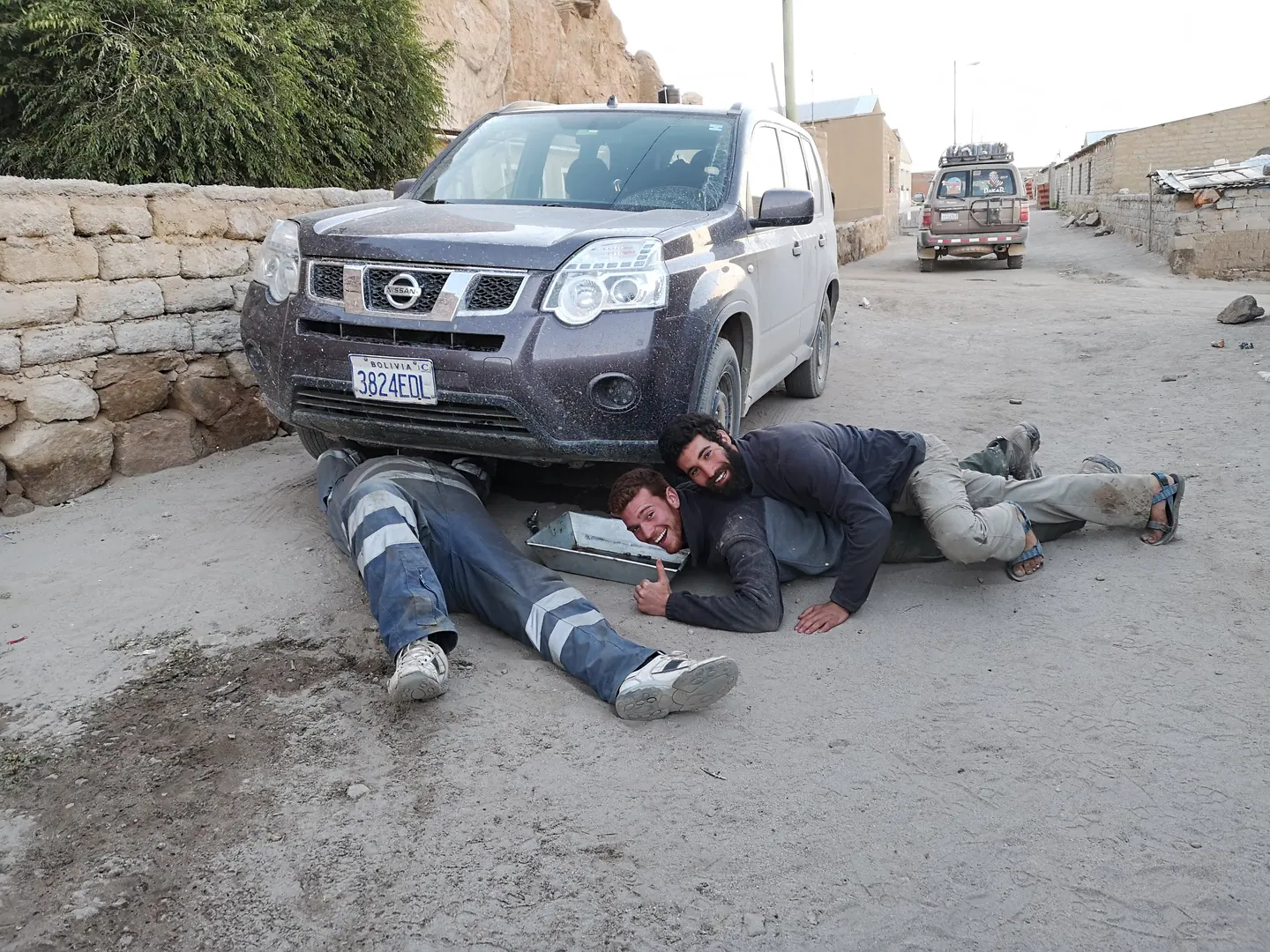
After an evening of checks he tells us we’ll meet early tomorrow morning and that we need to go and buy several adhesives and materials with which we can improvise a repair until we reach Uyuni, where the garages will be able to fix the problem completely.
We go up to our rooms and get ourselves sorted for the evening.
In the little village there was finally a signal. After three days of disconnection we already feel we have to share, and we talk to our families, unload a bit of the madness of the last few days and signal that everything is fine — if you can call it that.
After a long day we make ourselves a proper dinner, cards, the alcohol that didn’t break, and a light optimism blows through the camp.
Morning of the seventh day
I let the others catch up on sleep, realising there’s no reason for all of us to watch the mechanic fix the car.
I do the shopping for the materials the hostel owner asked for and we meet to start the repair.
Despite the exhaustion I get to sit with the guides and the hostel owner while they prepare breakfast, and enjoy the leftover pancakes the tourists didn’t eat.
After breakfast we start work. The hostel owner returns to his work overalls and we go under the vehicle, and after two hours of repairs he manages to seal the source of the leak.
I go and wake the others, and we carry on the journey to Uyuni.
We leave the village with hugs and many thanks to everyone who helped, and set off on a slow drive that makes our hearts jump at every blow the vehicle takes.
Further along, the track becomes much more orderly and in certain parts is even asphalted. A long day at the end of which we reach Uyuni, which at this stage looks to us like Manhattan at the very least.
In Uyuni, although the trip is over, the real mission is only beginning. We have to return the vehicle, we have a day and a half, and in it we need to repair the car and still manage the most important thing: the Salar.
The hostel owners from the start of the journey help us again and send us to several good garages in town.
Beyond the oil problem we have a rear section that’s almost completely torn off, and the hostel manager recommends we repair it rather than let the hire company fleece us.
I meet a panel beater who tells me that if I leave the vehicle with him in the evening he’ll manage to repair it by morning. We decide to go with that option and use the time until evening for sunset on the Salar.
Getting to the Salar is easy, and the drive, although a little frightening, is enjoyable, and again the sense of freedom and the advantages of having our own jeep let us draw in the beauty of this genuinely special place to the full. But it’s precisely in these moments that I realise the desert of southern Bolivia we discovered over the last few days is a no less important and no less unforgettable part of the trip to the Salar region. The German was right.
We go back to Uyuni and leave the vehicle with the panel beater.
From there we go back into town and to a recommended pizzeria, where each of us savours his own pizza, and then back to the hostel for a long evening of cards, already starting to recount with a smile what we’d been through over the last few days.
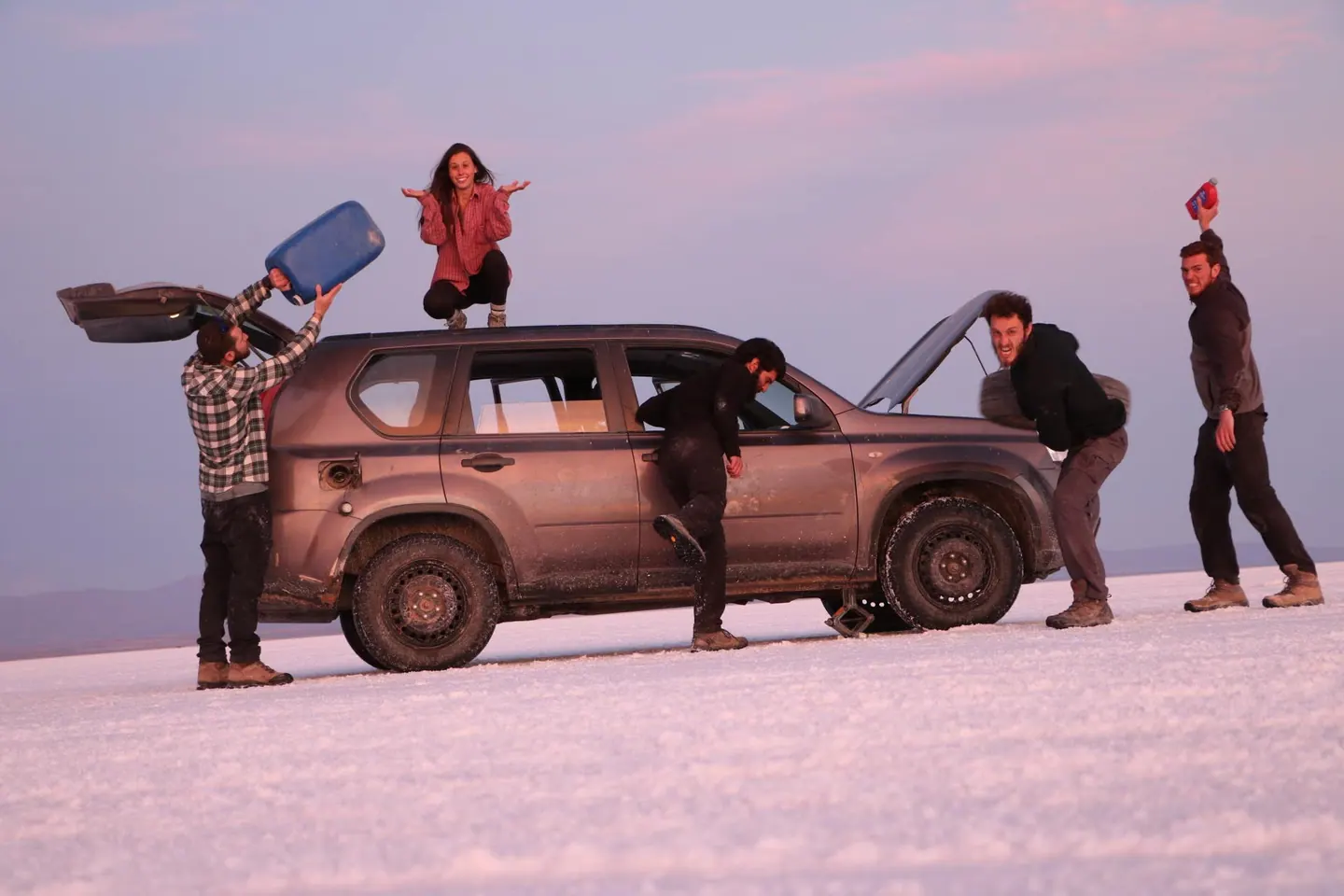
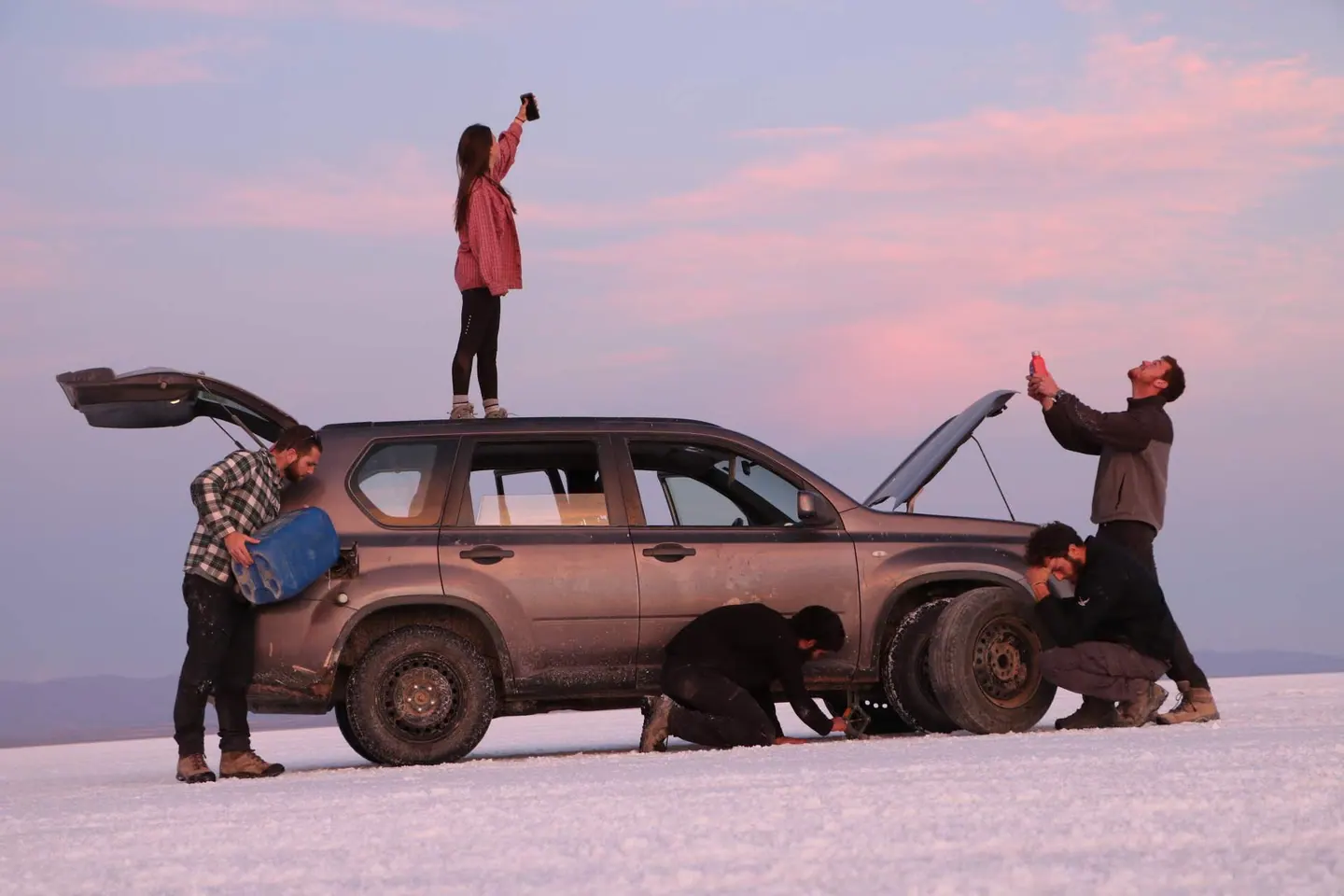
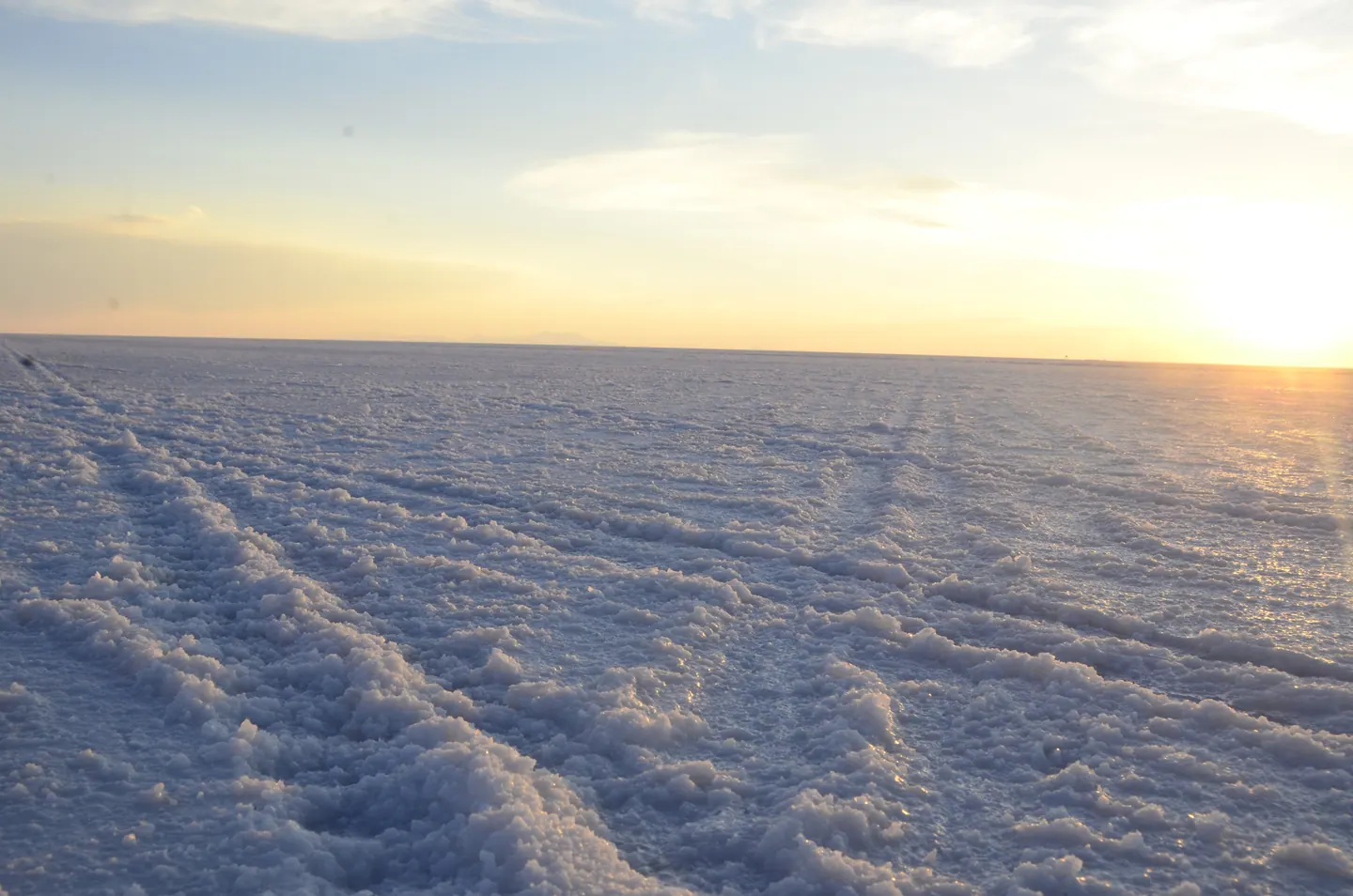
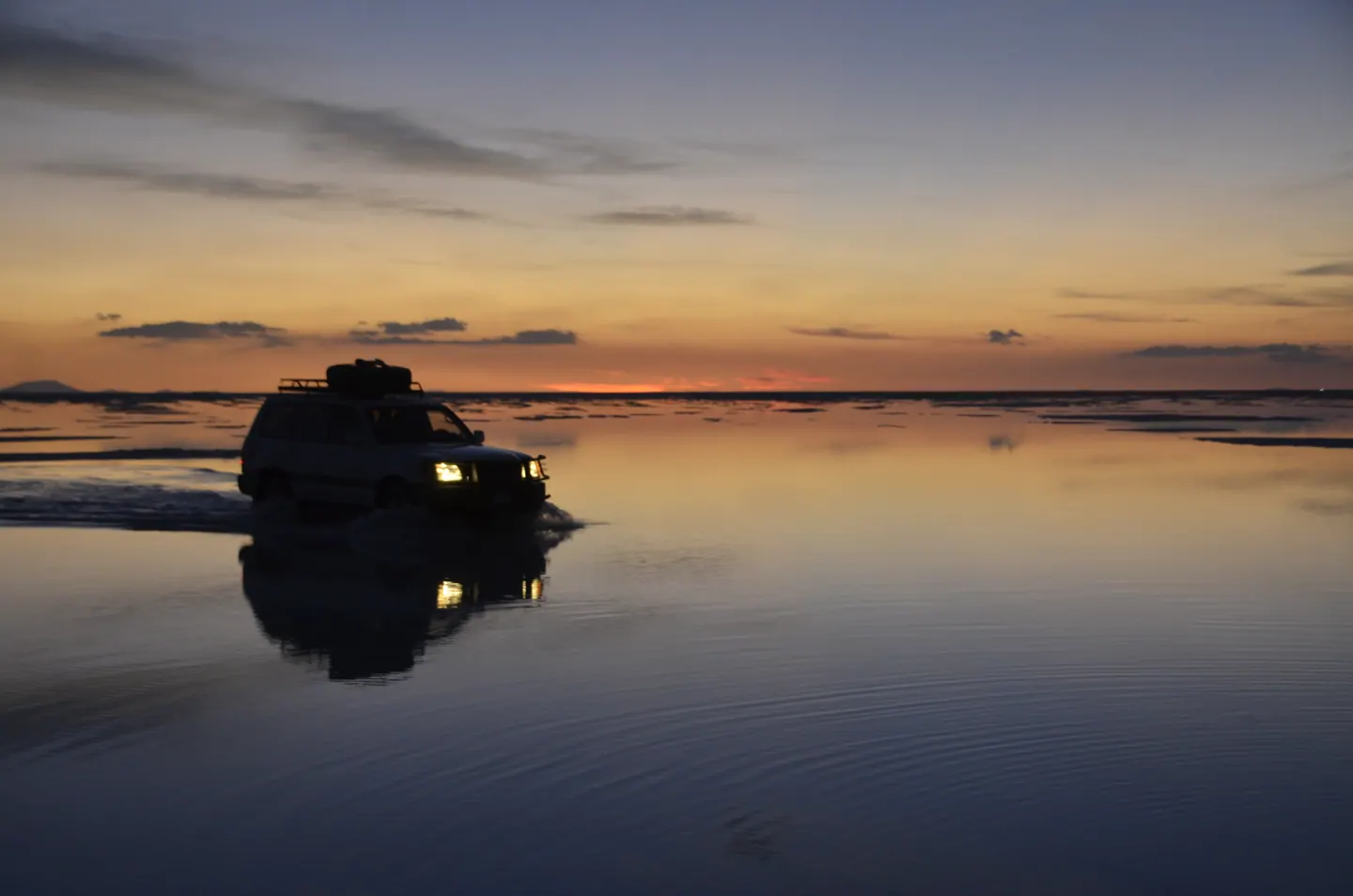
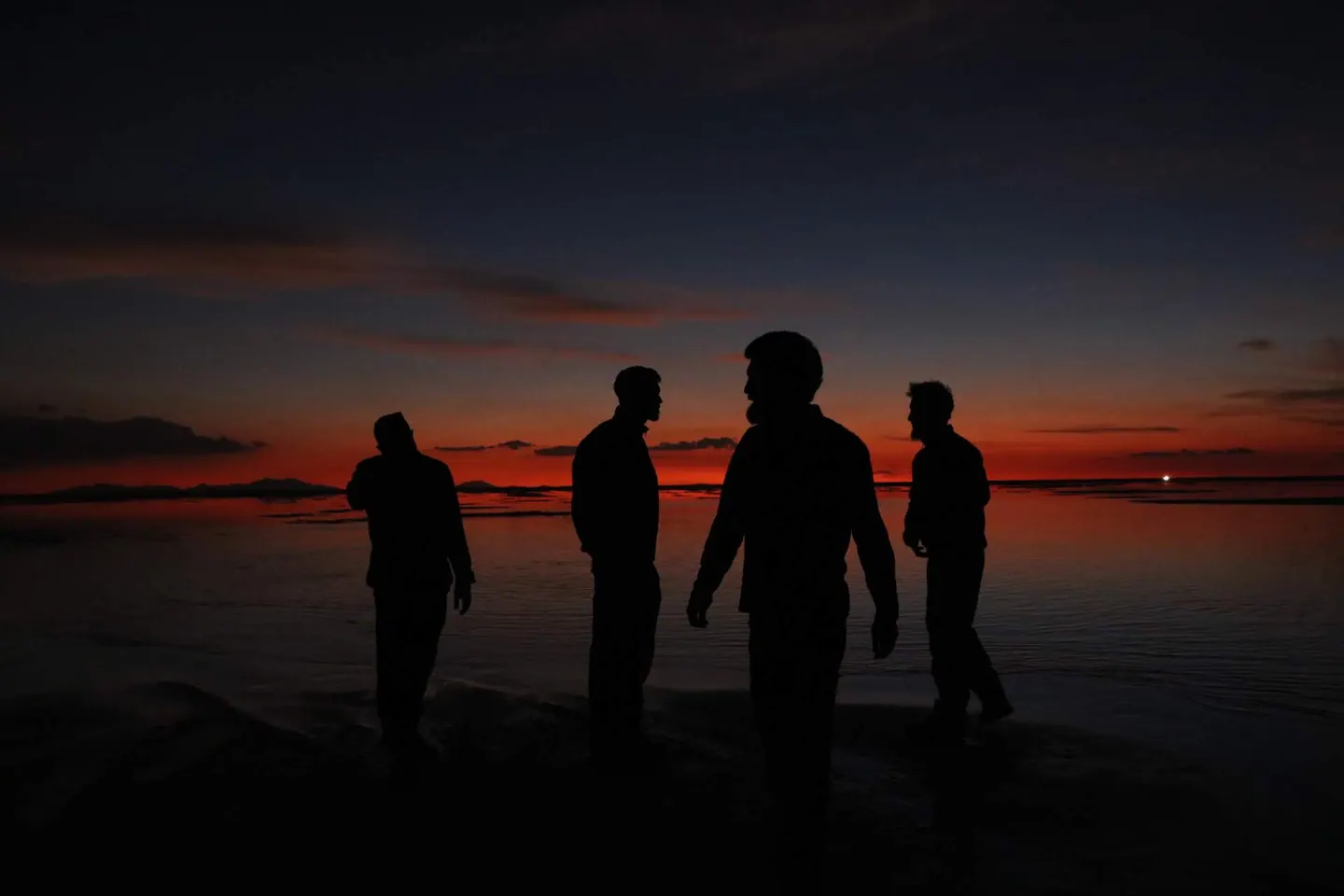
The photos on the Salar, which are the essence of the trip — between despair and breathtaking beauty.
Morning of the eighth day
Early in the morning I get a message that the car is ready. We go to collect it, and what a surprise I get.
I admit I’d never had to repair the rear of a nearly torn-off vehicle, but the panel beater’s work was simply extraordinary and I couldn’t believe such a result was possible. So if you’re a panel beater and you’re reading my blog, I salute you.
Encouraged by the quality of the repair, I take the car on to the second garage, which is supposed to completely fix the engine oil leak. The guy looks a bit busy despite having promised to keep to the timings, and I realise I need to push him.
After hours of pestering and asking, he finally deals with us and the car is ready towards evening.
With a spruced-up car we set off as darkness falls towards Sucre, a long drive until the small hours, at the end of which we reach a hostel full of travellers from all over the world. We’re definitively back to business.
Morning of the ninth and last day
We thought we’d already been through everything. Apparently not.
On the morning of the last day I go out to return the vehicle to the hire agency, and see that the police in Sucre got up early today and have already managed to clamp our car.
I can’t believe the jeep is causing us problems in the city too. Complete frustration.
The real problem is that we’re in Bolivia, so I went and paid the fine, and then I have to call the officers who put the clamp on to release it.
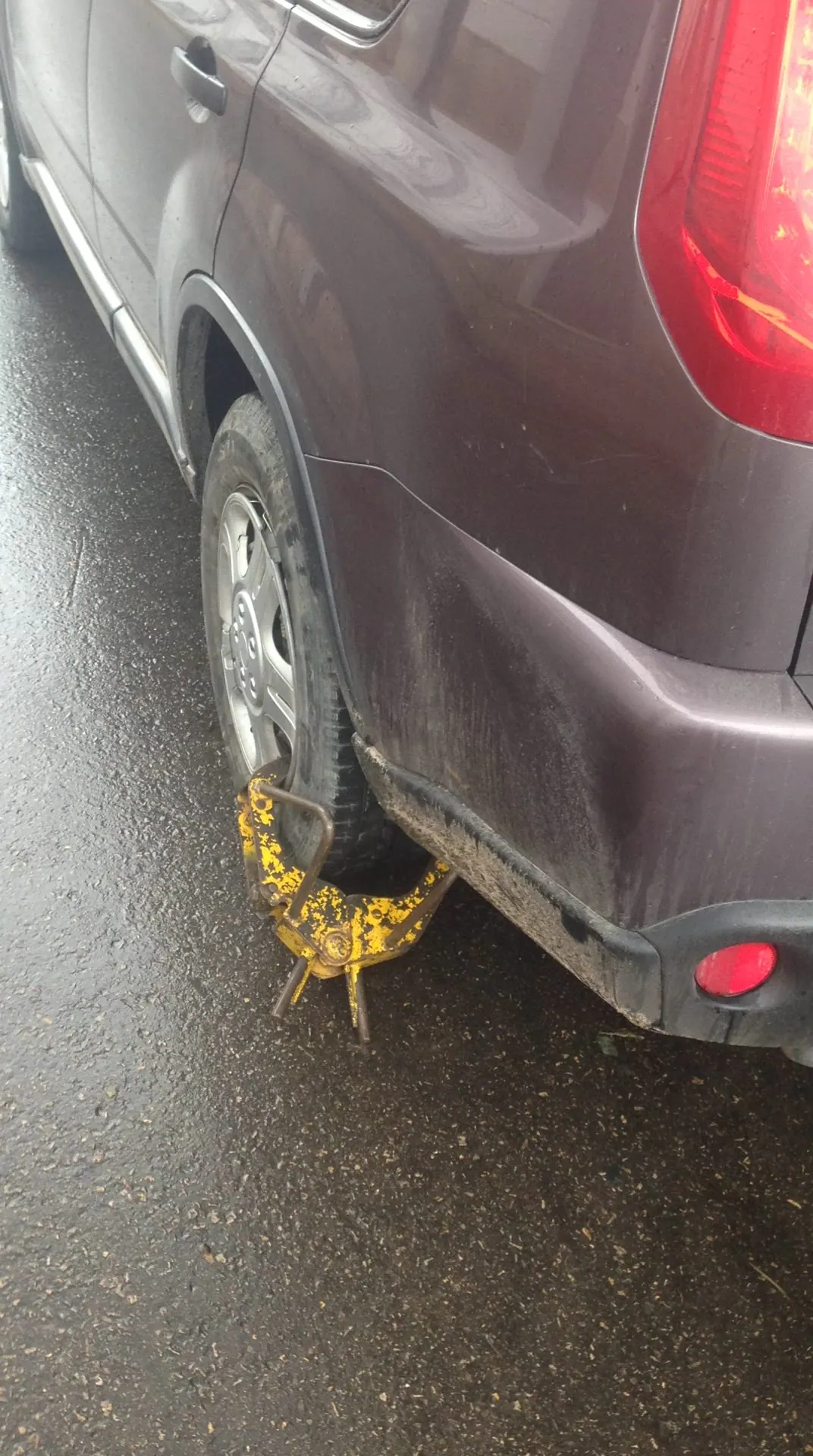
The first stage, the payment, takes time but passes without trouble. But the stage of finding the police becomes a sad mission which, looking back, is fairly funny: I’m simply running after patrol cars through the streets of Sucre, waiting for the police to stop for me so somebody can finally get this clamp off.
After an hour of chasing they call me and say the police have arrived at the hostel. I show them the paid ticket and finally we’re free.
One last challenge in the journey and that’s it: returning the vehicle.
We head to the car hire company smiling on the outside but with our hearts pounding inside.
At the hire company they explicitly told us not to enter the Salar, and half the car had been broken until yesterday’s repairs.
I approach the man who hired us the vehicle confidently and tell him everything is fine with the car and that it was excellent apart from a small puncture. He isn’t too fazed and calls the company’s vehicle inspector to go over the car.
Very quickly the smiles of the hire company staff turn into suspicious faces, and the tone of the conversation changes.
They explain that there’s a small crack in the windscreen — something else that happened along the way which I’d already forgotten to mention — and that this small break is an opening for large cracks that will eventually destroy the entire windscreen.
Well, on one hand they hadn’t picked up anything about the engine oil or the rear section, which is progress. But a windscreen is definitely a story.
The inspector can’t estimate the damage for us and decides to go round the garages, and on the way to check that everything is fine with the car when driving. Raz and I offer to join him, and he agrees.
During the drive I use every tool I discovered on the trip for connecting with people. Fluent Spanish, Jerusalem, the Holy Land, compliments from here to eternity — and slowly the tough official opens up and tells me about his personal life.
After a short drive we reach the Nissan dealership in the city. A Nissan agent comes to the car and says the repair will cost the equivalent of no less than four thousand shekels.
I’m horrified to hear it, and try to work out from the inspector whether there’s another option. He says there are non-original windscreens at better prices, but because the vehicle is relatively new and has original parts they only replace with original parts.
I push a bit more and finally persuade him just to go by a few more garages.
At the next garages the prices are already far more sane, ranging between six hundred and a thousand shekels for a windscreen.
Further into the drive the inspector opens up completely and tells me he wants to meet foreign women and one day visit Jerusalem too. We start heading back towards the agency and I ask the inspector what he’s going to say, and then, between the lines of what he’s saying, I realise I have an opening. I pull out 200 bolivianos, about a hundred shekels, and tell him: this is for you, take a foreign girl to a good bar and save something towards a trip to Jerusalem along the way, and when you come you can stay at mine.
It worked. The inspector tells me he appreciates the offer and that he’s going to tell the owner of the hire company that Nissan has no new windscreens, and that if they want to repair the vehicle they’ll need to buy the cheap windscreens.
We get back to the hire company, my heart pounding at two hundred. The inspector and the manager hold an intense conversation between them. The manager doesn’t look pleased, but after a few minutes he totals up the damages for us and I see that the price of the windscreen is the price of the cheap windscreen. The others, who weren’t in the car, pull a few faces about the price, but I tell them to calm down, pay, and that I’ll explain everything once we’re out of here.
We pay — not a small sum, in spite of everything — and leave the hire company. The others hear the real story behind the windscreen and laugh. The last challenge passed successfully.
From the car hire company we carry on to the cafeteria in Sucre’s main square, a blowout meal to mark being back to normal. Finally we’re rid of that jeep.
What a journey we went through with it. Not always easy, but definitely empowering, and an experience for life.
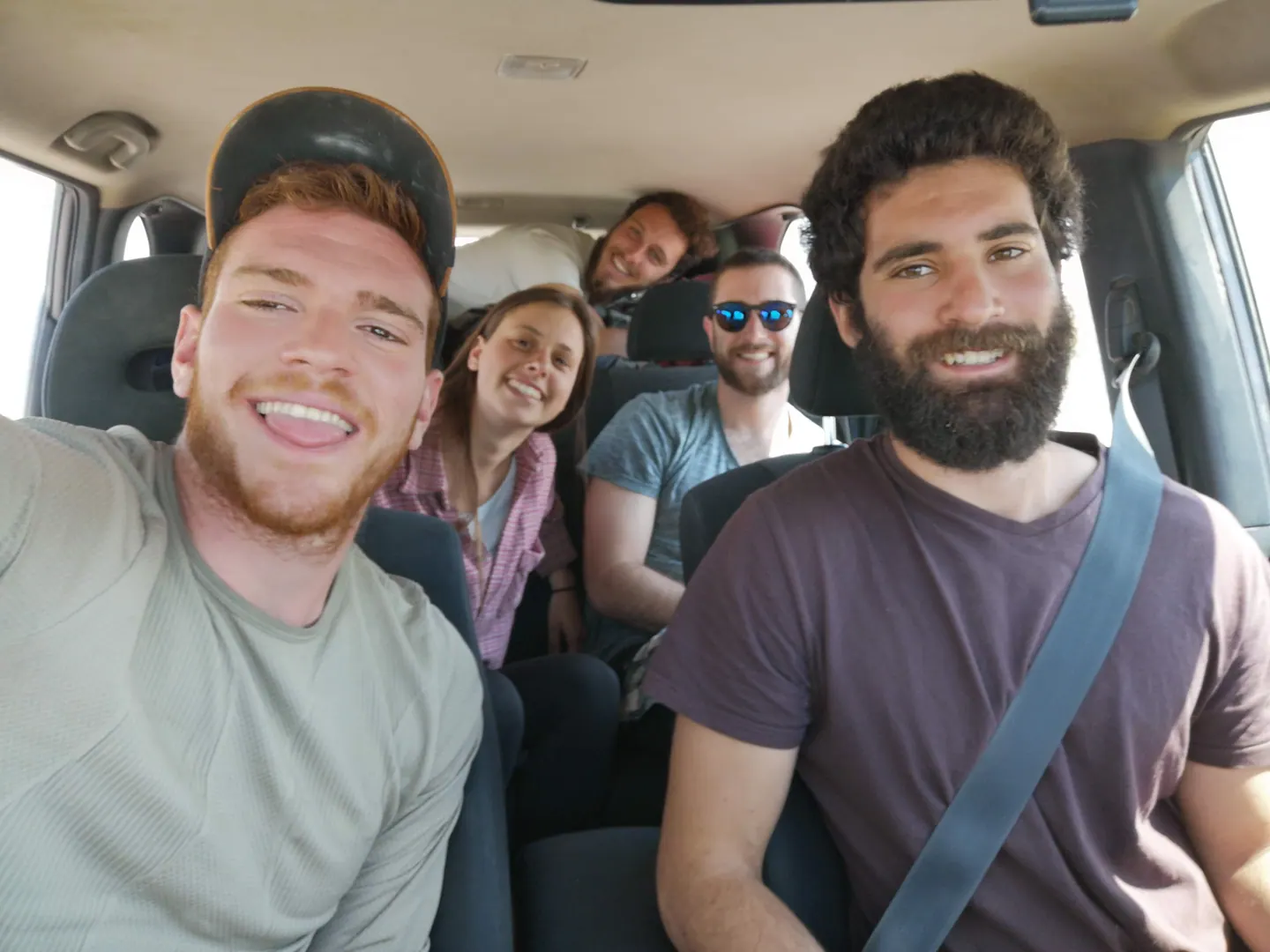
Thank you to my partners on the journey, Raz, Shoham, Neri and Einav. I couldn’t have asked for better people to spend those days with.
And thank you to the loyal readers who read all of it. I’d be glad if you passed it on if you enjoyed it.
Ofek.